







Building Legal Document AI with TX Text Control: From RAG and Contract Analysis to AI-Assisted Editing

Learn how TX Text Control uses AI, RAG, and deterministic document processing to create intelligent workflows for analyzing, summarizing, and reviewing legal documents. Learn how AI can analyze private legal knowledge, suggest goal-oriented changes, and apply them as controlled, reviewable tracked changes directly to documents.
Legal documents are one of the most compelling use cases for generative AI. They contain large amounts of structured information that must be reviewed, compared, summarized, negotiated, and transformed throughout their lifecycle. Therefore, contracts, NDAs, policies, terms and conditions, compliance documents, and other agreements are natural candidates for AI-assisted workflows. However, merely sending the text of a contract to a large language model only solves part of the problem.
Real legal applications require interaction with actual documents. These applications must be able to understand sections and clauses, retrieve relevant information from a knowledge base, analyze contractual language, summarize agreements, compare provisions against organizational standards, propose alternative wording, and ultimately incorporate those changes into the document in a controlled and reviewable manner. Combining AI with mature document processing technology, such as TX Text Control, is particularly powerful in this regard.
Learn more
Explore TX Text Control AI, including local models, private RAG, and document processing in .NET applications.
Introducing TX Text Control AI: Private AI for Real Document Workflows in .NET C#
From Document AI to Legal Document Workflows
A typical AI integration starts with a simple question:
This is useful, but it is only the beginning. A more advanced legal application might ask:
Or:
And eventually:
These requests represent two very different technical problems. The first is primarily a summarization task. The second requires additional organizational knowledge and is therefore an excellent candidate for retrieval-augmented generation (RAG). The third request is even more complex because the AI is not only analyzing a document. It is proposing a modification to the actual legal document. TX Text Control provides the document layer for these workflows, and AI provides language understanding and reasoning.
Contract Summarization
Although contract summarization is probably the most straightforward legal AI scenario, simply extracting all text and asking an LLM to summarize it is rarely sufficient for a production application. A useful legal summary should be structured around the information that users actually need. Depending on the type of agreement, this may include information about the parties involved, the effective date, the term, renewal provisions, termination rights, payment obligations, confidentiality requirements, liability provisions, indemnification, the governing law, and other important clauses.
Rather than requesting an unrestricted summary, an application can use TX Text Control to extract the relevant document content and instruct the AI to return a defined structure. The result can then be presented alongside the original document within the application. This is an important architectural principle for legal AI: The AI result should augment, not replace, the source document. Rather, it should augment it. The lawyer, contract manager, or other responsible user should always be able to return to the actual contractual language from which an AI-generated conclusion was derived.
Contract Analysis
Summarization answers the question:
Contract analysis goes further:
An application can analyze an agreement for specific provisions and provide structured results, including liability limitations, termination rights, automatic renewal, indemnification obligations, data protection requirements, intellectual property provisions, governing law, payment terms, service-level commitments, and non-compete or exclusivity provisions. Rather than producing an unrestricted narrative response, the AI can provide structured data that the application can validate and display.
The application can retain the location or section of each finding so that the user can immediately inspect the original language. This combination is important because the LLM performs semantic interpretation while TX Text Control provides deterministic access to the actual document.
Using RAG for Organization-Specific Legal Knowledge
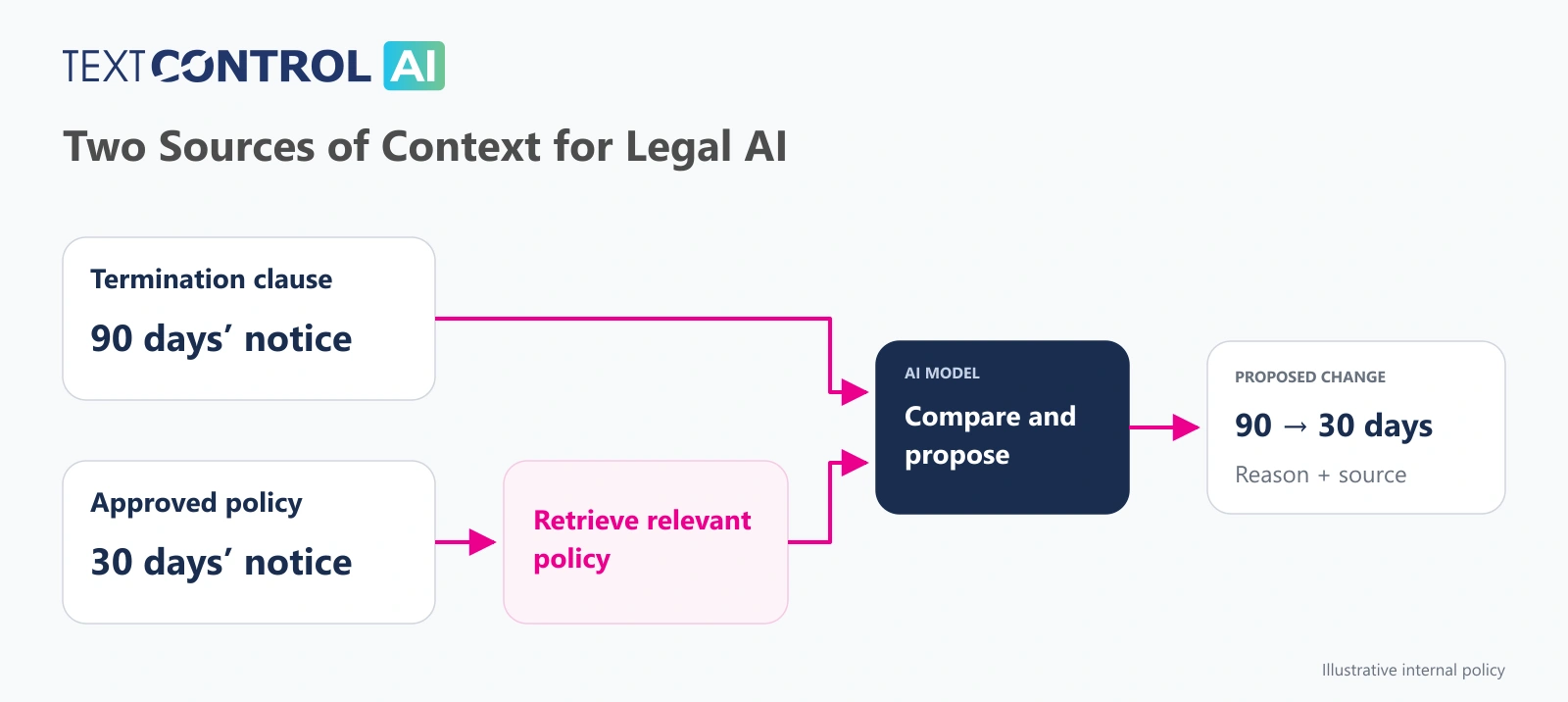
Real value emerges when contract analysis is combined with an organization's legal expertise. While a general-purpose LLM may understand what a limitation of liability clause is, it does not automatically know what your legal department considers acceptable. This is precisely why RAG is useful.
An organization could maintain a private knowledge base containing approved contract language, contracting policies, negotiation playbooks, standard clauses, previous agreements, compliance requirements, internal legal guidelines, and other relevant information. When analyzing a contract, the application retrieves relevant information from the knowledge base and provides it to the model alongside the corresponding contract content.
The question therefore changes from:
to something much more useful:
The AI now has two sources of context: The document being reviewed and the organization's approved knowledge base. This creates an architecture in which the RAG provides relevant legal context, the LLM reasons about that context, and TX Text Control provides and manages the actual business document.
Private RAG for Sensitive Documents
Privacy is especially crucial for legal applications since contracts often include confidential commercial terms, personal information, intellectual property, pricing information, acquisition details, employment conditions, and other highly sensitive data. TX Text Control AI enables the integration of local language models and private knowledge retrieval directly into .NET applications. This allows organizations to build architectures where documents, embeddings, retrieved knowledge, and potentially the entire inference process remain within their infrastructure.
For legal departments and industries with strict confidentiality requirements, this can change the scope of where AI can be used. Rather than deciding whether sensitive documents can be uploaded to an external AI service, developers can design workflows that align with an organization's security requirements.
Learn more
Build a local LLM chat in .NET C# with a GGUF model, streaming responses, and conversation history.
Going Beyond Analysis: Changing the Contract
Reading documents is only half of the legal workflow process. Eventually, someone needs to modify them. For example, consider a contract with a termination provision that does not align with the organization's standard policy. An AI system could identify and explain the issue.
That is useful, but the next logical request is:
At this point, document AI becomes document automation. Rather than attempting to generate an entirely new DOCX file, the AI should determine what needs to change and let the document processing layer perform the actual modification. Instead, it should identify what needs to change and allow the document processing layer to make the modifications. For instance, the workflow could identify the relevant section, retrieve the organization's approved termination policy via RAG, generate replacement text, find the relevant content in the document, and insert the new text as a tracked change. The resulting document is still an editable contract, not an AI-generated approximation.
AI Suggestions as Tracked Changes
Tracked changes are particularly valuable for legal AI because they naturally bridge the gap between automation and human review. Rather than silently replacing contractual language, AI-generated modifications can be introduced as revisions. Imagine asking:
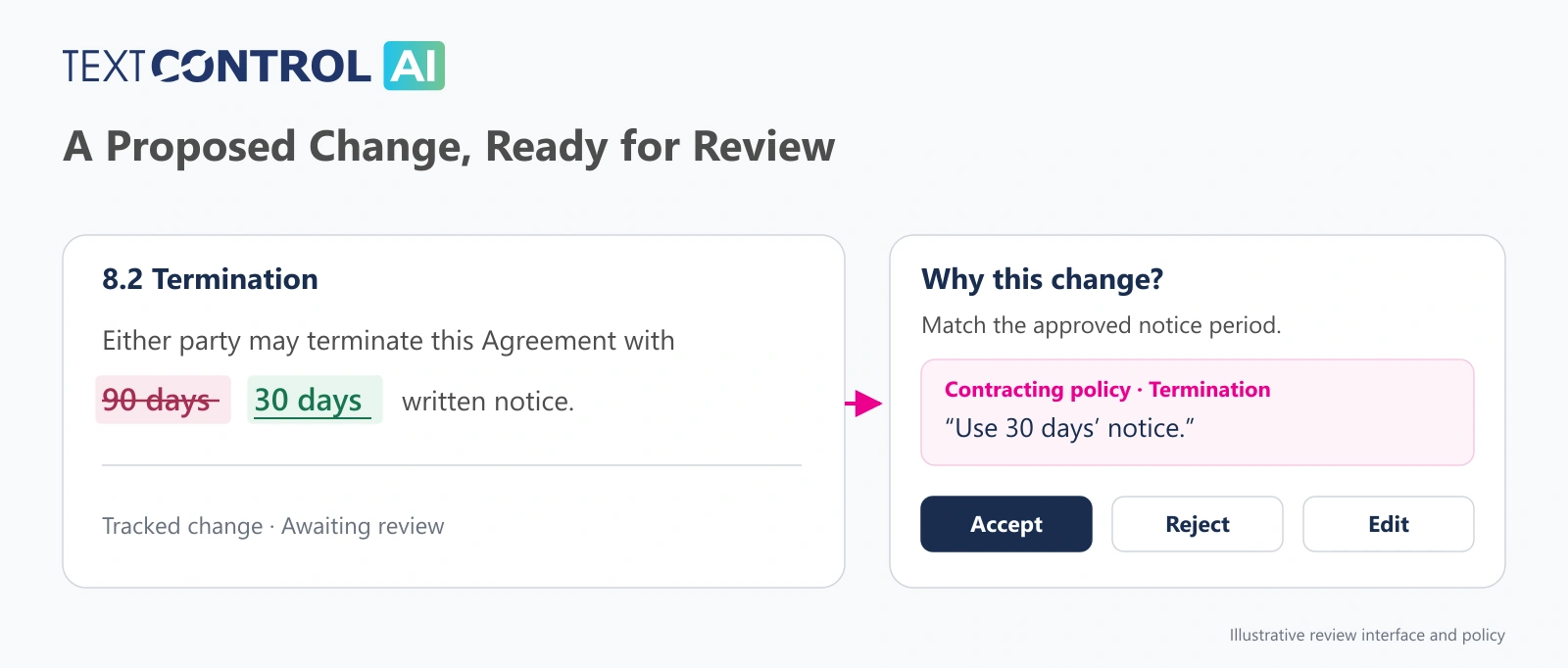
The application can analyze individual clauses, retrieve corresponding policies using RAG, determine where changes are appropriate, generate proposed language, and insert modifications using TX Text Control's track changes functionality. Then, the lawyer can see the original and proposed wording directly inside the document and accept or reject each modification. This makes AI another participant in the established review workflow rather than an opaque process operating outside the document. This distinction is important for professional legal applications.
Changing Sections Toward a Specific Goal
Not every modification is simply about complying with a predefined template. Sometimes, the desired outcome is expressed as a business objective. For example:
These requests require reasoning that spans the entire document. Modifying one clause can impact terminology, references, definitions, numbering, and other sections. Therefore, a useful legal AI application needs to treat the contract as a document rather than an isolated string of text. The AI can determine intent and suggest changes, while TX Text Control manages the document's structure and modifications.
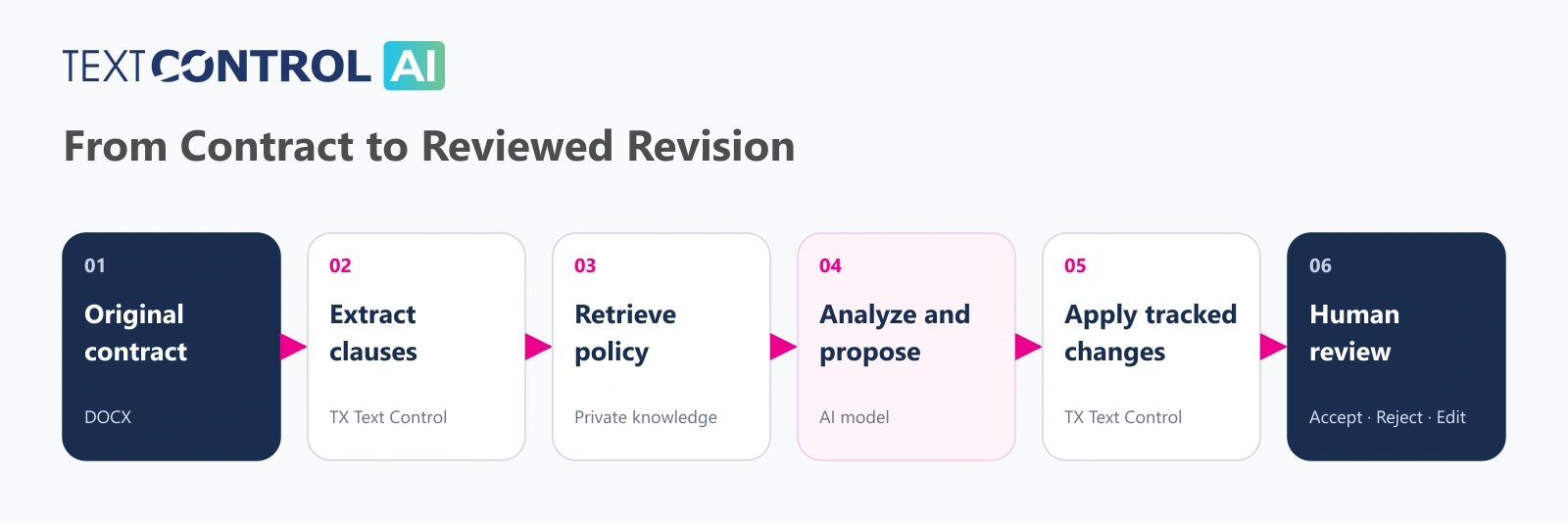
The resulting workflow can remain controlled: Document → Extract → Retrieve → Analyze → Propose → Modify → Review → Approve. Human review remains an explicit part of the process.
Explain Why a Change Was Made
Another important capability is explainability. If an AI system suggests replacing a clause, the reviewer should understand the reason why. Therefore, a legal AI application can produce more than replacement text. For each suggested change, it can provide structured information containing the original clause, the proposed clause, the reason for the change, the relevant internal policy, the retrieved reference material, and the source passages used to reach the conclusion.
TX Text Control provides the necessary document concepts to integrate these results into familiar review workflows, including tracked changes and comments. Therefore, the document itself can become the user interface for AI-assisted review. Rather than switching between an AI chat window and Microsoft Word, users can review AI suggestions where they matter most-directly inside the contract.
Combining Probabilistic AI with Deterministic Document Processing
One of the most important architectural concepts when building professional document AI is the separation of responsibilities. While large language models excel at understanding language, identifying semantic relationships, summarizing information, interpreting instructions, and generating alternative wording, they are not document processing engines.
Document formats such as DOCX and PDF contain various elements that should be handled deterministically, including structures, formatting rules, fields, sections, headers, footers, tables, lists, tracked changes, and comments. TX Text Control provides this deterministic document layer. The AI determines what should happen, while TX Text Control determines how it happens to the document.
Our MCP approach uses the same principle, in which AI agents translate natural-language intentions into structured operations while TX Text Control performs the actual document processing.
Learn more
See how AI agents translate natural-language requests into MCP tool calls while TX Text Control performs the document operations.
AI Natural Language Document Generation with MCP and TX Text Control .NET
A Concrete Implementation Workflow
For example, imagine a contract management application in which a user opens an existing DOCX agreement in the TX Text Control Document Editor and asks the AI to review the termination clause against the company's internal contracting policy. The user does not need to export the document, copy text into another application, or manually find the relevant policy. The entire workflow can be completed within the application.
TX Text Control loads the original DOCX document and provides access to its text and document structure. The application can work with the same document the user sees in the editor instead of creating a separate text-only representation as the primary document.
The application provides the document content and the user's instruction to the AI layer. The model identifies the termination provisions and determines which parts of the agreement are relevant to the request. Related definitions or cross-references can be included when they are necessary to understand the clause correctly.
The RAG layer searches the organization's private knowledge base for the applicable contracting policy, approved termination language, negotiation guidelines, and other relevant material. Only the most relevant information is added to the AI context rather than sending an entire legal knowledge repository to the model.
The LLM compares the contract language with the retrieved policy. Instead of returning only free-form text, the application can request structured results containing the affected clause, the detected deviation, the supporting policy, an explanation, and a proposed replacement.
The AI result is converted into deterministic document operations. The model describes what should change, but TX Text Control performs the actual modification. This prevents the LLM from having to recreate the DOCX document or manipulate its internal format directly.
TX Text Control locates the corresponding content in the original document and applies the proposed wording using tracked changes. Formatting, surrounding content, document structure, and other elements of the original document remain intact.
The application can display why the modification was proposed and which internal policy or retrieved source was used. The user sees both the explanation and the proposed revision in the context of the actual contract.
The lawyer or contract manager remains in control. Proposed changes can be reviewed, accepted, rejected, or edited using the application's normal document review workflow. AI assists the decision but does not replace the approval process.
After review, the same document can be saved as DOCX, converted to PDF, routed for approval, electronically signed, archived, or passed into another business process using TX Text Control.
This architecture makes the individual components replaceable. The AI layer can use either a cloud-based model or a locally hosted large language model (LLM), and the RAG implementation can use the organization's preferred vector database, search infrastructure, or document repository. Legal knowledge remains separate from the document processing engine and probabilistic AI operations remain separate from deterministic modifications to the document.
Most importantly, the final product of this workflow is more than just an AI response. Rather, it is the original business document with proposed changes that are understandable, reviewable, and controllable. This distinction transforms a generic AI integration into a real legal document workflow.
Building a Legal AI Assistant
Combining these capabilities makes much more sophisticated applications possible. For example, a legal AI assistant embedded in a contract management application could enable users to ask questions about the current document, summarize individual sections or the entire agreement, extract obligations and important dates, compare clauses with internal policies, search a private legal knowledge base, explain tracked changes, identify missing provisions, suggest alternative wording, and apply approved modifications directly to the document.
The interaction can remain conversational even though the underlying operations are highly structured. Users do not need to know which operations are required for a particular request, such as text extraction, RAG, an LLM call, a search through internal policies, or a document modification. The application determines the appropriate workflow based on the user's intent and uses the individual components behind the scenes.
The assistant could identify the relevant provisions, provide a concise summary, and link each finding to its location in the document. Then, the user could continue the conversation without starting a new workflow.
The application can retrieve the relevant internal policy via RAG, compare it with the contract's actual language, and highlight the differences. If the user decides a modification is appropriate, the next instruction can operate directly within the same document and context.
At this point, the assistant transitions from answering questions to orchestrating document operations. The LLM determines the user's intent and suggests appropriate language, and TX Text Control makes the necessary changes to the document. The application can preserve the document's formatting and structure, create tracked changes, add comments or explanations, and keep the original document available for comparison and review.
This conversational model can extend beyond individual clauses. For example, a user could ask the assistant to identify missing provisions, extract all obligations assigned to a specific party, find inconsistent defined terms, locate dates and renewal periods, compare multiple versions of an agreement, or evaluate the entire contract against an organization's legal playbook. Since the application has access to both the document and private organizational knowledge, it can evaluate these requests in the context of actual business requirements instead of relying exclusively on the language model's general knowledge.
This illustrates an important difference between a generic AI chatbot and an integrated legal AI assistant. A chatbot primarily provides answers. In contrast, an integrated assistant can connect those answers to underlying documents, private knowledge, deterministic document operations, and an explicit review process. Thus, the conversation becomes the interface for a much larger document workflow.
Because TX Text Control is part of the application, the workflow does not end with AI output. The modified document can continue through the existing document lifecycle, including editing, collaboration, approval, PDF creation, electronic signing, archiving, and any other application-specific processes. AI becomes just another capability within the document workflow, rather than a separate destination to which documents must be uploaded and from which results must later be transferred.
Your Documents. Your AI. Your Control.
The most interesting opportunity for AI in legal applications is not another chat interface. Rather, it is the ability to incorporate language understanding into existing document workflows, combining the flexibility of natural language interaction with the reliability of deterministic document processing.
RAG provides organization-specific knowledge. Large language models offer semantic comprehension and reasoning capabilities. TX Text Control provides access to documents and the infrastructure necessary for editing, tracking, generating, converting, and processing professional documents. Together, these technologies enable the development of legal AI applications that can do more than answer questions about contracts.
They can understand and summarize documents, compare them against private knowledge, analyze complex agreements, explain risks and differences, and propose goal-oriented modifications. They can also bring those changes back into the actual document for human review. The result is not AI replacing established legal processes but rather AI becoming an integral part of them.
ASP.NET
Integrate document processing into your applications to create documents such as PDFs and MS Word documents, including client-side document editing, viewing, and electronic signatures.





- Angular
- Blazor
- React
- JavaScript
- ASP.NET MVC, ASP.NET Core, and WebForms
Related Posts
Introducing TX Text Control AI: Private AI for Real Document Workflows in…
Today, we are excited to introduce the TX Text Control AI Preview, a suite of six NuGet packages and ten sample applications that integrate local generative AI, private knowledge retrieval, and TX…
AI Natural Language Document Generation with MCP and TX Text Control .NET
This article explains how AI agents can use natural language to create documents through an MCP server. Instead of letting a language model generate documents directly, the AI translates prompts…
Introducing Text Control Agent Skills
Text Control Agent Skills are structured definitions that teach AI coding assistants how to build applications with the TX Text Control Document Editor. Each skill contains step-by-step…
AI-Ready Legal Documents: What to Fix Before Adding AI
Summerization, analysis, and risk detection: AI can help legal professionals process documents faster and more efficiently. However, before integrating AI into your legal document workflows, it's…
Explaining Contract Tracked Changes Automatically Using .NET C# and AI
Learn how to use AI and .NET C# to automatically explain changes to contracts, improving the document review and collaboration processes. This comprehensive guide provides practical implementation…