









Creating Your First ASP.NET Reporting Application

The MailMerge and ServerTextControl components of TX Text Control .NET Server for ASP.NET enable server-side reporting in Web Forms. A template.docx merges with XML data via a button click handler, and the Page_Load event configures the output, returning the completed result as a PDF.

Create Your Application
-
Open Visual Studio and create a new ASP.NET Empty Web Application.
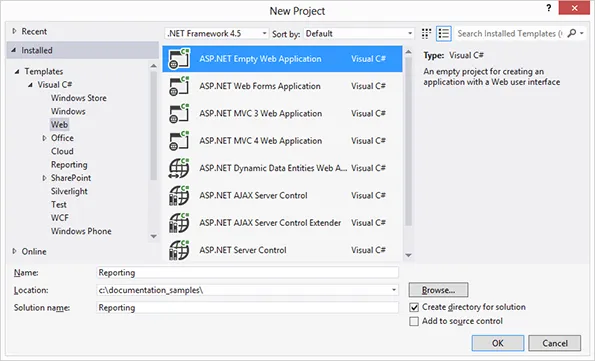
-
In the Solution Explorer, select the project and choose Add New Item... from the Project main menu.
In the opened dialog Add New Item, select Web Form and confirm with Add.
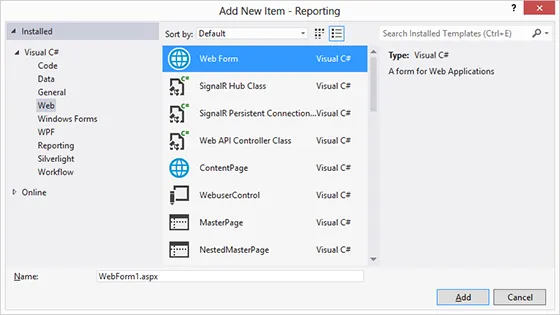
-
In the Solution Explorer, select the newly created Web Form and choose Component Designer from the View main menu.
Find the MailMerge component in the Toolbox and drag and drop an instance onto the Component Designer form.
Repeat this step with the ServerTextControl component.
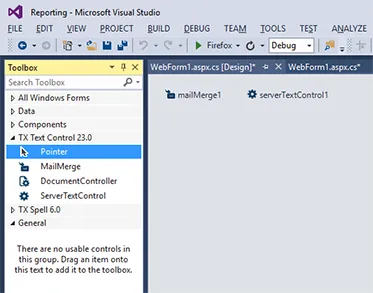
-
Select the MailMerge component and set the TextComponent property to serverTextControl1 - the name of the inserted instance of ServerTextControl.
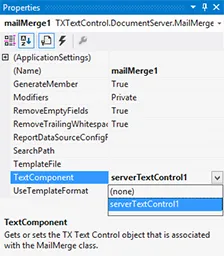
-
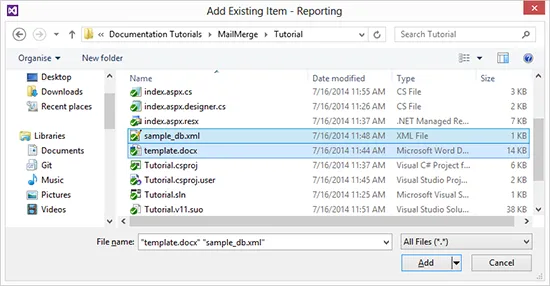
While the project is selected in the Solution Explorer, choose Add Existing Item... from the Project main menu.
In the opened dialog Add Existing Item, browse to the following sample folder:
%USERPROFILE%\Documents\TX Text Control 29.0.NET Server for ASP.NET\Samples\ASP.NET\CSharp\Documentation Tutorials\MailMerge\Tutorial
or
%USERPROFILE%\Documents\TX Text Control 29.0.NET Server for ASP.NET\Samples\ASP.NET\VB.NET\Documentation Tutorials\MailMerge\Tutorial
Select the following 2 files: template.docx and sample_db.xml and click the Add button.
-
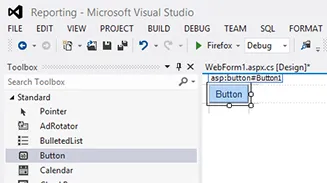
Select the Web Form in the Solution Explorer and choose Designer from the View main menu.
Find the Button control in the Toolbox and drag and drop an instance onto the Web Form.
-
Double-click the button and insert the following code to the event handler:
protected void Button1_Click(object sender, EventArgs e)
{
  // create a DataSet from the sample XML data source
  System.Data.DataSet ds = new System.Data.DataSet();
  ds.ReadXml(Server.MapPath("sample_db.xml"), System.Data.XmlReadMode.Auto);

  // load the template
  mailMerge1.LoadTemplate(Server.MapPath("template.docx"),
  TXTextControl.DocumentServer.FileFormat.WordprocessingML);

  // merge the template with data
  mailMerge1.Merge(ds.Tables[0]);

  // save the document as PDF into a byte array
  byte[] data;
  mailMerge1.SaveDocumentToMemory(out data,
  TXTextControl.BinaryStreamType.AdobePDF, null);

  // return the document to the browser for download
  Response.Clear();
  Response.AddHeader("content-disposition",
  String.Format("attachment;filename={0}", "created_by_txtextcontrol.pdf"));
  Response.ContentType = "application/pdf";
  Response.BinaryWrite(data);
  Response.End();
}
Protected Sub Button1_Click(sender As Object, e As EventArgs) ' create a DataSet from the sample XML data source Dim ds As New System.Data.DataSet() ds.ReadXml(Server.MapPath("sample_db.xml"), System.Data.XmlReadMode.Auto) ' load the template mailMerge1.LoadTemplate(Server.MapPath("template.docx"), TXTextControl.DocumentServer.FileFormat.WordprocessingML) ' merge the template with data mailMerge1.Merge(ds.Tables(0)) ' save the document as PDF into a byte array Dim data As Byte() mailMerge1.SaveDocumentToMemory(data, TXTextControl.BinaryStreamType.AdobePDF, Nothing) ' return the document to the browser for download Response.Clear() Response.AddHeader("content-disposition", [String].Format("attachment;filename={0}", "created_by_txtextcontrol.pdf")) Response.ContentType = "application/pdf" Response.BinaryWrite(data) Response.[End]() End Sub -
In the same code view, add the following code to the Page_Load event:
protected void Page_Load(object sender, EventArgs e)
{
  InitializeComponent();
}
Protected Sub Page_Load(sender As Object, e As EventArgs) InitializeComponent() End Sub -
Compile and start the application. Press the button to create the report that is returned as a PDF file.
ASP.NET
Integrate document processing into your applications to create documents such as PDFs and MS Word documents, including client-side document editing, viewing, and electronic signatures.





- Angular
- Blazor
- React
- JavaScript
- ASP.NET MVC, ASP.NET Core, and WebForms
Related Posts
Creating an ASP.NET MVC DocumentViewer Application With Razor
Create a simple ASP.NET (MVC) application that uses the HTML5 document viewer.
Creating an ASP.NET MVC Application With Razor
This tutorial covers integrating TX Text Control .NET Server for ASP.NET into an ASP.NET MVC application. It walks through installing the TXTextControl.Web NuGet package, creating an MVC 5…
Creating an ASP.NET Web Forms AJAX Application
TX Text Control .NET Server for ASP.NET integrates into Web Forms by dragging the TextControl component from the Visual Studio Toolbox onto a designer form. Setting Dock to Window fills the area.…
Automatically Reconnect to the Server and Recover the Document
When a WebSocket connection drops, the TX Text Control editor automatically reconnects and recovers the document using browser local storage. The implementation saves document state client-side…
New Online Sample: Build your First Report
A new interactive online demo walks through building a report with TX Text Control in three steps: preparing JSON data in a live editor, creating a template with merge fields and repeating blocks,…