








Introducing HEDBridge: A Modern Migration Path for Legacy HighEdit HED Documents

We are excited to announce the release of HEDBridge, a powerful tool designed to facilitate the migration of legacy HighEdit (HED) documents to modern formats. This innovative solution ensures your valuable content remains accessible and compatible with current technologies.
For many years, Heiler HighEdit was used as a document editing and processing component in business-critical applications. It was particularly common in healthcare environments where applications generated and stored large numbers of documents in the proprietary HED format.
HighEdit was discontinued many years ago. However, the applications built around it did not simply disappear.
Today, organizations still maintain archives containing hundreds of thousands, or even millions, of HED documents. Some of these files are decades old, but the information they contain is still important. In many cases, it must remain accessible for operational, regulatory, or legal reasons.
This becomes a significant challenge when an organization replaces a legacy application, migrates to a new electronic health record (EHR) system, modernizes its infrastructure, or simply wants to eliminate technical dependency on unavailable software.
This is exactly what HEDBridge was built for.
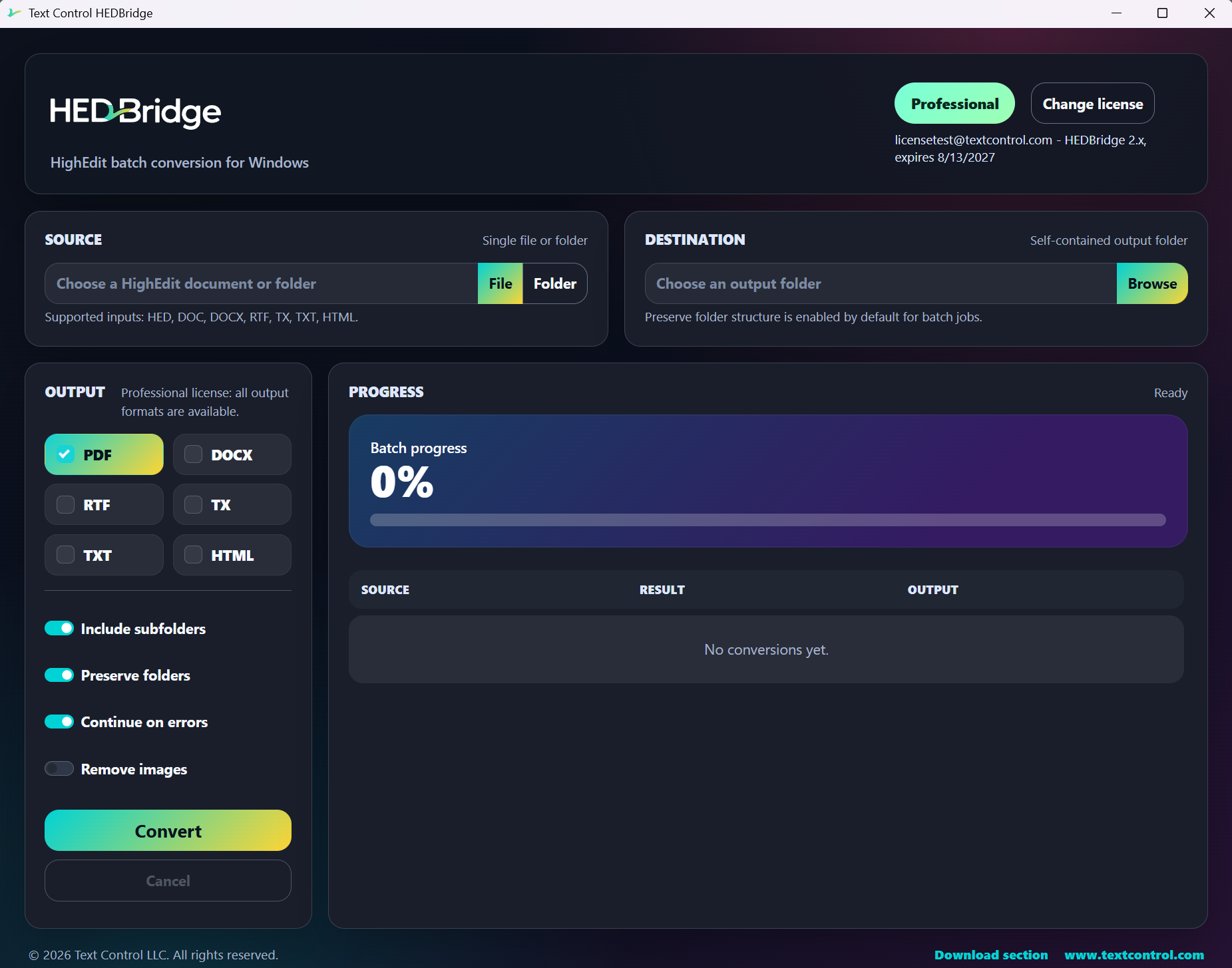
HEDBridge is a dedicated migration and conversion solution for HighEdit HED documents. It converts HED files into modern, standardized formats and extracts data for further processing.
Legacy Documents Should Not Define Your Future Infrastructure
Relying on an outdated application solely because it is the only reliable way to access historical documents creates an unnecessary dependency.
The application itself may depend on outdated Windows environments, obsolete database components, unsupported libraries, or infrastructure that is becoming increasingly difficult to maintain.
Simply keeping the original HED files in an archive does not solve the problem either. While the files may still exist, without software capable of interpreting them, they become difficult to use.
Therefore, a migration strategy should consider the documents themselves an important part of the modernization project.
Rather than maintaining the entire legacy technology stack indefinitely, HEDBridge can convert the existing HED archive into formats usable by modern applications and document management systems.
Convert HED Files to Modern Document Formats
Different migration projects have different requirements. There is no single output format appropriate for every archive.
Therefore, HEDBridge supports conversion into several widely used document formats, including:
- PDF for reliable viewing and distribution
- PDF/A for long-term archival
- DOCX for editable documents in Microsoft Word-compatible workflows
- RTF for compatibility with existing rich-text systems
- HTML for browser-based applications and web workflows
- TX Text Control format for applications that continue to process or edit documents using TX Text Control
This allows organizations to choose the target format based on how the documents will be used after migration.
For example, an archive intended primarily for long-term retention can be migrated to PDF/A. Documents that must remain editable can be converted to DOCX. Documents created with TX Text Control during application modernization can retain a structured representation that can be loaded directly into new workflows.
Built for Archive Migration, Not Individual File Conversion
Migrating a legacy document archive is much more complex than manually converting a few files. A real migration project may involve hundreds of thousands or even millions of documents. Therefore, conversion needs to be automated, predictable, and capable of becoming part of a larger migration process.
HEDBridge is specifically designed with these scenarios in mind. It can be integrated into automated batch workflows to process complete archives systematically. This allows you to combine document conversion with other migration tasks, such as database migration, document classification, validation, and metadata processing. You can also import the resulting files into a new system.
The objective is not merely to open an old HED file. Rather, the objective is to provide a reliable path for moving an entire document archive away from discontinued technology.
A Particularly Important Challenge in Healthcare
Legacy document archives are especially prevalent in the healthcare industry. HighEdit technology has been integrated into healthcare and EHR applications, including systems like NextGen. Over many years of operation, these systems can accumulate large archives of documents containing clinical and administrative information.
When a clinic, physician group, hospital, or healthcare organization transitions to a new platform, access to historical records cannot simply disappear with the old application.
The organization may need to migrate the documents to the new EHR, store them in a separate archive, make them available through a document management system, or preserve them for long-term storage.
HEDBridge provides the conversion layer for this process. It can transform existing HED documents into standard formats that the new environment understands without requiring the destination system to support the obsolete HighEdit format.
Keep PHI Inside Your Infrastructure
When it comes to document migration in healthcare, another important consideration arises: Protected Health Information (PHI). Uploading sensitive patient documents to an external online conversion service may be unacceptable from security, privacy, or compliance perspectives. HEDBridge is designed for secure, on-premises processing.
Conversion can take place inside the organization's infrastructure or controlled migration environment. HED documents do not have to be uploaded to a third-party cloud conversion service.
For healthcare migrations, this significantly simplifies the migration process architecture: the source documents, conversion process, extracted data, and resulting files can all remain within the controlled environment.
From HighEdit to TX Text Control
Text Control has often been used as a replacement for HighEdit in applications that originally relied on it. This creates another migration scenario. An organization may not want to eliminate document editing or generation from its application. Rather, the organization wants to modernize the application by replacing the discontinued HighEdit technology with a supported document processing platform.
HEDBridge can facilitate that transition. While the new application uses TX Text Control for document generation, editing, viewing, PDF processing, and other document-related functionality, existing HED documents can be migrated.
This approach separates two important parts of the modernization project: migrating the historical archive and developing the new application's document workflows.
Everything You Need to Get Started
HEDBridge has its own website where you can find everything you need to evaluate, integrate, and deploy the converter.
At highedit.textcontrol.com, you can find complete product documentation, technical information about supported HED files and output formats, licensing and pricing options, and the latest downloads for testing and deployment.
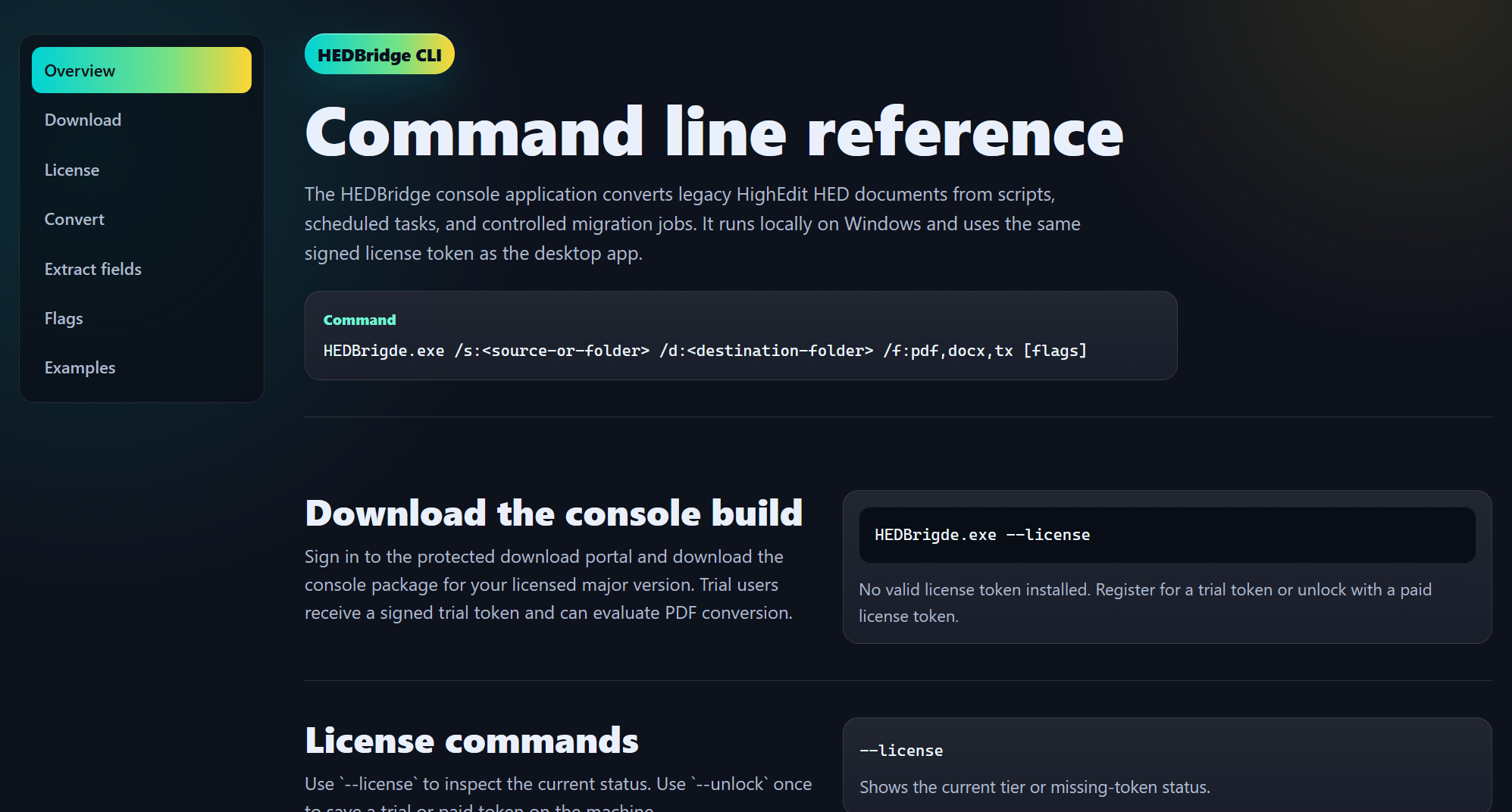
The website is also the central resource for updates and technical guidance as you plan your HED migration project.
Whether you want to convert a small set of legacy documents for evaluation or prepare for a large-scale archive migration, HEDBridge is the best place to start.
Visit highedit.textcontrol.com to learn more about HEDBridge and how it can help you modernize your legacy HighEdit document archives.
ASP.NET
Integrate document processing into your applications to create documents such as PDFs and MS Word documents, including client-side document editing, viewing, and electronic signatures.





- Angular
- Blazor
- React
- JavaScript
- ASP.NET MVC, ASP.NET Core, and WebForms