







Against the Trend: Why We Still Believe in Transparent, Perpetual Software Licensing. And Why You Should Too

Software licensing is a complex topic, and the industry has been shifting toward subscription-based models. However, we believe transparent perpetual licensing offers significant advantages to both developers and users. In this article, we explain why we are committed to perpetual licensing and how it benefits our customers.

As a software vendor that has helped drive innovation in document processing for more than 30 years, we have witnessed the software industry evolve at an unprecedented pace. Each year brings new frameworks, programming languages, cloud platforms, AI models, deployment models, and development practices that promise to increase productivity. Most of these changes genuinely move the industry forward. We have evolved from desktop controls to web applications, from the .NET Framework to .NET Core, and from Windows-only deployments to Linux and containers. Today, we are investing heavily in AI integration and WebAssembly.
However, not every trend deserves to be followed.
One such trend, which has become increasingly common over the past few years, has little to do with technology itself. Instead, it affects something that every software company eventually depends on but often evaluates too late: Licensing.
When developers compare software libraries, they naturally focus on the technical aspects first. They benchmark performance, evaluate APIs, study documentation, build proofs of concept, and verify whether a component integrates well into their application. These are all important steps, but another question deserves the same level of attention.
What happens years after the component has become part of your product?
That answer is often found not in the product documentation, but in the licensing terms.
A Software Component is a Long-Term Business Decision
Selecting a document processing software development kit (SDK) is fundamentally different from choosing a small utility package or another NuGet dependency that can easily be replaced later. Once document generation, PDF conversion, reporting, editing documents, mail merging, or adding digital signatures become part of an application, they quickly evolve into critical business infrastructure. Templates are created, workflows are automated, and customers build their daily operations around this functionality. Developers also become experts in the API.
At that point, the software library is no longer just another dependency. It has become part of the product itself.
Replacing such a component years later is rarely a straightforward process. It often involves redesigning document templates, validating rendering differences, rewriting business logic, updating automated tests, and ensuring that years of generated documents continue to meet customer expectations and regulatory requirements. For organizations operating in healthcare, banking, insurance, manufacturing, or the public sector, these validation efforts can represent months of engineering work and considerable business risk.
This is why software libraries are rarely short-term investments. Many organizations use the same component for ten, fifteen, or even twenty years. The licensing model you accept today may affect your business long after the original developers have moved on to other projects. This fact alone should make licensing one of the first topics discussed during a technical evaluation instead of one of the last.
A Trend That Creates Unnecessary Risk
Over the past few years, we have observed a noticeable shift in the software component industry. An increasing number of vendors are shifting from perpetual licensing to subscription-only models. This shift appears entirely reasonable on the surface. Customers pay an annual fee and receive continuous updates and access to the latest version of the software. For many software as a service (SaaS) products, this model makes perfect sense.
However, developer components are different.
Unlike an online service, a software library becomes embedded inside another product. Once integrated, the library may remain there for many years, silently performing an essential function while the surrounding application continues to evolve. This long lifecycle changes customers' expectations when purchasing the software.
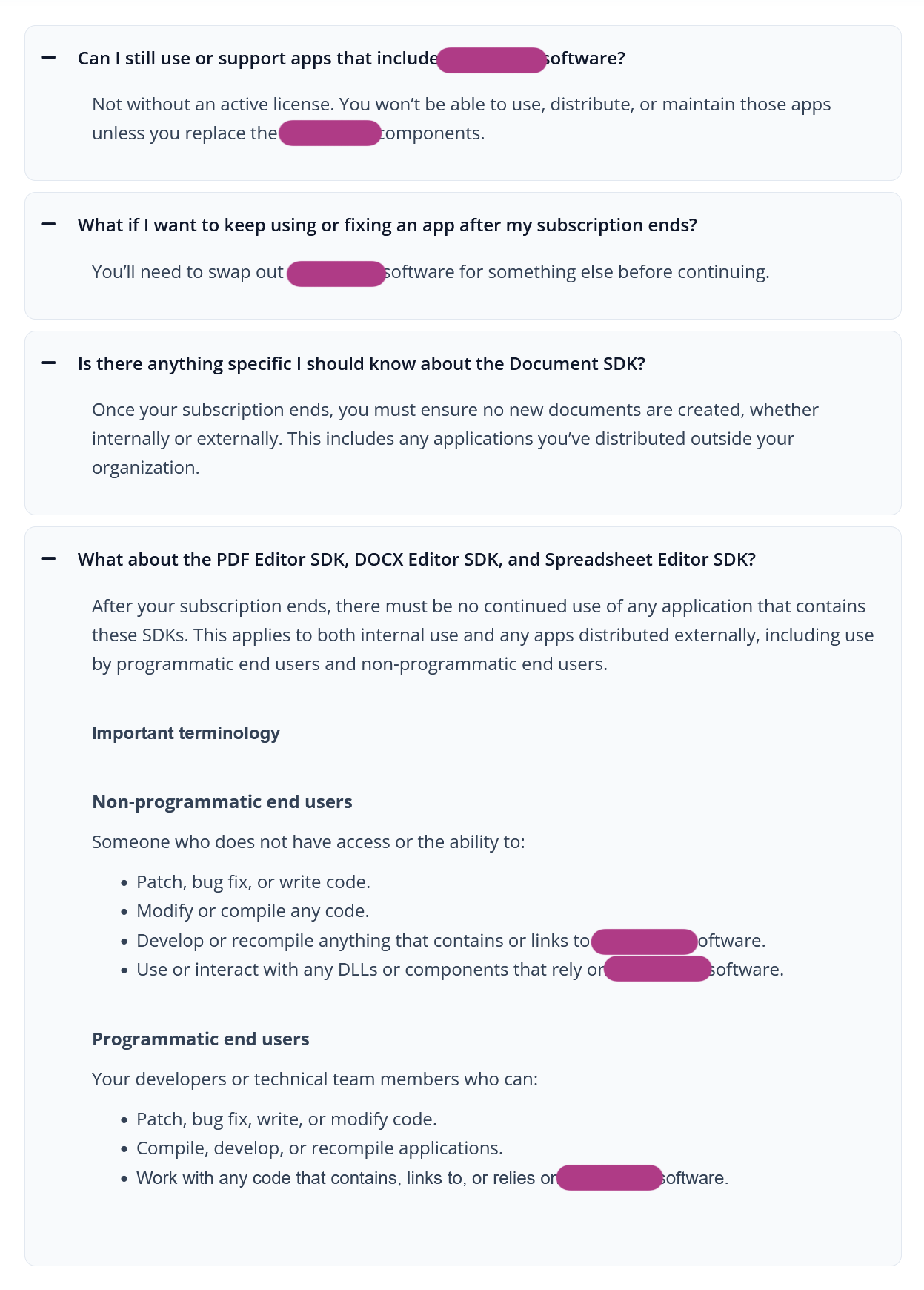
Recently, I came across the licensing FAQ of another well-known vendor in our industry. One section immediately caught my attention because it stated that customers must ensure no new documents are created once a subscription expires. Another section explains that applications containing certain SDK components may no longer be used after the subscription ends.
The screenshot below is taken directly from that FAQ.
Here is another sample from a competitor's FAQ. It states that, after canceling, you must update your applications so that they no longer use the SDK components.
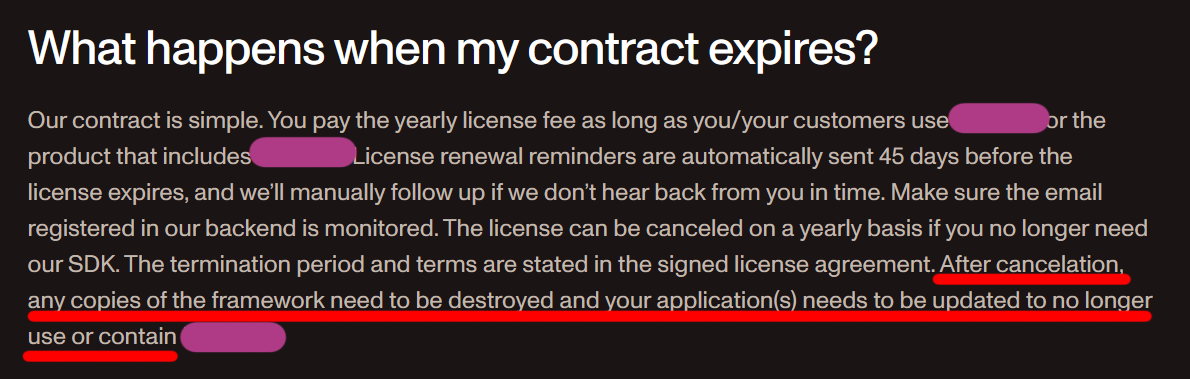
I had to read this FAQ twice because I could hardly believe what it actually meant. I haven't seen this level of vendor lock-in since SAP.
I am intentionally not mentioning the vendor because the purpose of this article is not to criticize a competitor. Rather, the screenshot illustrates a broader trend of which developers should be aware when evaluating third-party components. Licensing models can differ significantly, and these differences become particularly important after a product has been integrated into commercial software.
Imagine developing an ERP solution, healthcare platform, or banking application that depends on document generation. Your software has been running successfully for years. Thousands of customers rely on it every day. Your application, customers, and business requirements have not changed. The only thing that has changed is the status of your subscription with a third-party vendor.
In our opinion, whether this should affect your ability to operate your software is a question every organization should carefully consider before making a purchasing decision.
Transparency Builds Trust
One aspect of modern software purchasing concerns me almost as much as the licensing models themselves.
Many software vendors no longer publicly disclose their prices. Instead, prospective customers must fill out contact forms, schedule demonstrations, or negotiate with sales representatives just to determine if a product fits their budget. While every company has its own sales strategy, I believe this approach unnecessarily complicates what should be a straightforward evaluation process.
As developers and software architects, we prefer to make informed decisions. Before investing engineering time in a proof of concept, we need to understand a product's technical capabilities and commercial implications. Pricing and licensing terms should be transparent. Customers should not have to interpret pages of legal language to understand what rights they are purchasing.
Every customer should be able to immediately answer a few fundamental questions.
- What exactly am I buying?
- Which rights do I receive?
- Can I continue supporting my application if I choose not to renew maintenance?
- Will my deployed applications continue working exactly as before?
- Will I ever be forced to replace this component because my licensing situation changes?
These are not legal edge cases. Rather, they are practical business questions that influence long-term software architecture as much as performance benchmarks or supported platforms do.
Transparency builds confidence. Customers who clearly understand the product and its licensing model are better able to make informed purchasing decisions, which are far more likely to result in successful long-term partnerships.
Why We Continue to Believe in Perpetual Licensing
At Text Control, we have chosen not to follow the industry trend of subscription-only licensing. We continue to offer perpetual developer licenses because they provide predictability, which is becoming increasingly valuable in enterprise software.
When you purchase a perpetual license, you acquire the right to use that version of the software indefinitely. If you decide not to renew your maintenance subscription at some point in the future, the outcome is straightforward. You will no longer receive new releases, platform updates, new features, bug fixes, or technical support published after your subscription expires. However, the version you purchased remains yours to use under the terms of your license.
This means your existing applications will continue to operate exactly as before. You can maintain your software, ship updates, support your customers, and build upon the version you originally licensed. Nothing will suddenly stop working just because a renewal date has passed. There are also no hidden runtime restrictions that will require you to disable document generation or remove SDK components from applications that may have been deployed years ago.
We believe this distinction is fundamental because it separates ownership from maintenance. Maintenance should provide access to future innovation, not determine whether customers retain the rights they have already purchased.
A Better Partnership for Everyone
Some argue that perpetual licensing primarily benefits customers. However, we believe it also benefits software vendors by creating a healthier, more balanced relationship.
When customers are free to continue using the version they already own, software vendors cannot rely on mandatory renewals to generate recurring revenue. Every renewal must be earned by continually improving the product. Vendors must invest in new platform support, performance improvements, developer experience, security updates, modern APIs, AI integration, and responsive technical support because customers will only renew if they believe these improvements are worth the investment.
In other words, perpetual licensing aligns incentives.
Customers are protected because their existing investment remains secure, and vendors are motivated to continuously innovate rather than depend on contractual obligations. Renewals become expressions of customer satisfaction instead of administrative necessities.
Looking back over more than three decades of developing TX Text Control, we believe this philosophy has contributed significantly to the long-term relationships we have built with customers around the world. Many organizations have renewed their maintenance subscriptions year after year, not because they were required to, but because they wanted access to our continuous improvements. We consider this a much stronger foundation for a business relationship than any licensing restriction could ever provide.
Predictability Matters
Software projects rarely fail because one software development kit (SDK) renders a document a few milliseconds faster than another. More often, long-term challenges arise from unexpected dependencies that were not fully understood during the initial evaluation. Licensing can be one of those dependencies.
Once a document processing library is deeply integrated into an application, replacing it is rarely appealing. The engineering effort, testing requirements, customer impact, and business risk involved can easily exceed the original purchase price many times over. This is why licensing requires careful consideration before writing the first line of integration code.
Our advice is simple. Evaluate software components not only by their features, performance, and documentation but also by the long-term implications of their licensing models. Understand exactly what rights you receive, what will happen if you decide not to renew maintenance, and whether your investment will be protected throughout your application's lifetime.
These answers should never be surprising.
Against the Trend
For more than thirty years, our licensing philosophy at Text Control has remained remarkably consistent because we believe it reflects the kind of relationship customers deserve. We openly publish our pricing because transparency should begin before the first conversation with our sales team. Our licensing terms are written in a way that developers can understand without requiring legal interpretation. We offer genuine perpetual licenses because customers should own the software version they purchase. Finally, we make maintenance renewals optional because we want every renewal to be based on the value we deliver, not on the fear of losing rights that have already been paid for.
Technology will continue to evolve, and so will we. We will continue to invest in faster document processing, AI-powered development, modern deployment models, browser-based editing, cloud-native architectures, and every other innovation that helps our customers build better software. At the same time, we are comfortable going against industry trends when we believe they create unnecessary uncertainty for the organizations that depend on our products.
For us, this is not simply a licensing decision. It is a philosophy that has guided our company since the beginning.
We believe customers should understand exactly what they are buying. They should know what rights they receive, what obligations they have, and what will happen if they decide not to renew maintenance years from now. They should never encounter unexpected restrictions after a software component has become deeply embedded in their products.
Ultimately, the strongest software partnerships are not built by making it difficult for customers to leave. They are built by providing outstanding technology, continuously delivering innovation, and treating customers with transparency and respect to earn their business year after year.
That is why we continue to believe in transparent, perpetual software licensing, and we think you should too.
Frequently Asked Questions
TX Text Control is licensed using genuine perpetual developer licenses. When you purchase a license, you own the licensed version indefinitely. Your investment is protected, and you are not required to maintain an active subscription to continue using the version you purchased.
Your applications continue to work exactly as before. You retain the right to use the licensed version of TX Text Control indefinitely. When your subscription expires, you simply stop receiving new product releases, feature updates, bug fixes, and technical support published after the subscription end date.
Yes. You may continue developing, maintaining, and shipping applications that use the licensed version of TX Text Control. There are no runtime restrictions or requirements to remove the software from your existing applications.
No. Applications built with your licensed version continue to run without interruption. Your customers are not affected if you decide not to renew your subscription, and you can continue supporting your software using the version you already own.
We believe software components become long-term dependencies within commercial applications. Perpetual licensing provides predictability by ensuring that customers retain the rights to the version they purchased while remaining free to renew their subscription whenever they want access to new features and updates.
An active subscription includes access to all new product releases, feature enhancements, bug fixes, compatibility updates for new .NET versions and platforms, and technical support. Renewing your subscription ensures you always have access to the latest improvements.
No. Subscription renewals are entirely optional. You decide whether the latest features, platform support, and ongoing improvements provide value for your projects. If you choose not to renew, you simply continue using the version you already licensed.
No. TX Text Control does not require a cloud-based licensing service or periodic online validation to keep your applications running. Once licensed, your software operates independently without relying on external activation servers.
Yes. If you decide to renew your subscription at a later date, you can upgrade to a current version and continue benefiting from the latest features, platform support, performance improvements, and technical assistance.
Yes. We believe transparency builds trust. Our pricing and licensing information are publicly available so you can understand both the technical capabilities and commercial investment before contacting our sales team.
Yes. In addition to individual developer licenses, we offer volume licensing, team licenses, and site licensing options for organizations with multiple developers. Our sales team can review your current usage and recommend the most cost-effective licensing model.
Absolutely. As development teams grow and projects evolve, licensing requirements often change. We are happy to review your existing licenses, help you determine whether additional developer licenses are needed, and recommend team, site, or enterprise licensing options that best fit your organization.
ASP.NET
Integrate document processing into your applications to create documents such as PDFs and MS Word documents, including client-side document editing, viewing, and electronic signatures.





- Angular
- Blazor
- React
- JavaScript
- ASP.NET MVC, ASP.NET Core, and WebForms
Related Post
Unlock the Full Value of Your TX Text Control License
Are you getting the most from your TX Text Control license? In addition to document editing, your license includes powerful technologies for document generation, PDF processing, digital…