









Sign PDF Documents with an X.509 Certificate on a Hardware Device

TX Text Control can be used to retrieve certificates from a hardware device (such as the Windows certificate store, smart cards and PIV cards, USB tokens). This article shows how to use an X.509 certificate stored on a Windows machine in the Windows certificate store.

TX Text Control can digitally sign Adobe PDF and PDF/A documents with X.509 certificates. An X.509 certificate is a digital certificate that implements the widely accepted X.509 Public Key Infrastructure (PKI) standard that verifies that a specific public key belongs to a user, computer, or service identity contained in the certificate. The certificate can be assigned in the Save
Document Signing Methods
There are two approaches to signing PDF documents with TX Text Control:
- Sign the whole document with a digital certificate
- Sign individual signature fields with a digital certificate(s)
In both approaches, signatures can be created with PFX, DER Cer, or Base64 CER certificate files, loaded from raw data, or selected from the local certificate store.
Windows Certificate Store
The following method opens a dialog box that allows the user to select the desired certificate from the local Windows certificate store. The selected certificate is returned and can be used to sign the document or the signature fields in a PDF document.
The X509Certificate2UI class provides a user interface for selecting and viewing X.509 certificates. The following code uses the SelectFromCollection method to open a certificate selection dialog. All registered certificates, including smart cards, are listed in the dialog.
static X509Certificate2 RetrieveCertificate() {

   // get and open certificate store for current user
   X509Store store = new X509Store(StoreLocation.CurrentUser);
   store.Open(OpenFlags.ReadOnly | OpenFlags.OpenExistingOnly);

   // retrieve the certificate using the integrated Windows UI
   X509Certificate2Collection selectedCertificates =
           X509Certificate2UI.SelectFromCollection(
              store.Certificates,
              "Choose your certificate",
              "Please select a certificate that is used to sign the PDF.",
              X509SelectionFlag.SingleSelection);

   // return the first selected certificate with a private key
   foreach (var certificate in selectedCertificates) {
      if (certificate.HasPrivateKey)
         return certificate;
   }

   return null;
}
Signing the PDF
The CreateEncryptedPDF method takes the selected certificate and a document in the internal TX Text Control format and creates a PDF document signed with the given certificate.
public byte[] CreateEncryptedPDF(byte[] document, X509Certificate2 certificate) {
   byte[] bPDF;

   using (TXTextControl.ServerTextControl tx = new TXTextControl.ServerTextControl()) {
      tx.Create();
      tx.Load(document, TXTextControl.BinaryStreamType.InternalUnicodeFormat);

      // apply the first selected certificate
      TXTextControl.SaveSettings saveSettings = new TXTextControl.SaveSettings() {
         DigitalSignature = new TXTextControl.DigitalSignature(certificate, null)
      };

      // save the document as PDF
      tx.Save(out bPDF, TXTextControl.BinaryStreamType.AdobePDFA, saveSettings);
   }

   return bPDF;
}
The following code shows how to call this method with the certificate returned from the certificate store.
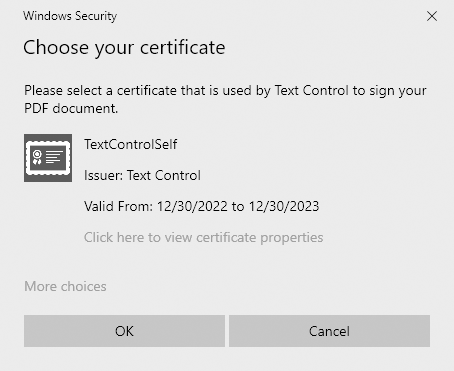
CreateEncryptedPDF(document, RetrieveCertificate());The dialog box for selecting the certificate from the local Windows certificate store is shown in the following screenshot.
ASP.NET
Integrate document processing into your applications to create documents such as PDFs and MS Word documents, including client-side document editing, viewing, and electronic signatures.





- Angular
- Blazor
- React
- JavaScript
- ASP.NET MVC, ASP.NET Core, and WebForms
Related Posts
ASP.NETASP.NET CoreDocument Conversion
Convert DOCX to PDF, PDF/A and PDF/UA in C# Using TX Text Control
Learn how to convert Word DOCX documents to PDF in C# using TX Text Control .NET Server. This tutorial covers file-based and in-memory conversion, PDF/A export, document metadata, font deployment,…
ASP.NETASP.NET CoreContent Controls
How to Extract Structured Data from Word Documents in C#
Learn how to extract tables, content controls, legacy form fields, and document metadata from Word documents with TX Text Control. This generic C# sample preserves the structure of documents and…
Reliable Document AI in .NET: LLM Tool Calling vs. LLM-Generated Files
Reliable document AI needs a deterministic engine. With LLM tool calling, the LLM decides what the document should contain, and TX Text Control generates the file.
ASP.NETASP.NET CoreDocument Generation
Building a Production-Ready PDF Generation Pipeline in C# with ASP.NET Core
Learn how to build a reliable PDF generation pipeline with TX Text Control and ASP.NET Core. Use durable background jobs, idempotency, renewable leases, PDF validation, and private artifact…
BASTA! 2026: Why AI Makes Deep Technology More Important Than Ever
This week, we exhibited our latest products and engaged with the developer community at BASTA! 2026. This conference highlighted the importance of AI in driving deep technology forward.