


ReportingCloud .NET Core Wrapper Released: Creating Documents on Windows, Linux, Mac and Docker

The ReportingCloud .NET Core wrapper ships as the TXTextControl.ReportingCloud.Core NuGet package for cross-platform document generation on Windows, macOS, and Linux. It matches the standard .NET wrapper API but returns Base64 image strings from GetTemplateThumbnails instead of objects.

 We just released a .NET Core version of the Text Control ReportingCloud .NET wrapper. .NET Core is the cross-platform, free and open-source managed software framework to create applications running on Windows, macOS and Linux. .NET Core is compatible with the .NET Framework, Xamarin and Mono, via the .NET Standard Library.
Using this new version, you can create .NET Core applications and deploy them to Linux servers. The name of the NuGet package is TXTextControl.ReportingCloud.Core and can be installed using the following Package Manager command:
PM> Install-Package TXTextControl.ReportingCloud.CoreWe decided to separate the new project and NuGet package for the .NET Core version from the classic .NET version, because of a small difference between the wrapper interfaces. .NET Core doesn't come with a built-in replacement for System.Drawing and there are several replacements in the works. There is CoreCompat.System.Drawing which is a direct port of the Mono implementation of System.Drawing, but it requires GDI+. There are several other implementations, but they are in beta or pre-release phase.
Until there is a standard implementation for image processing in .NET Core, the method GetTemplateThumbnails will return a string array of Base64 encoded images instead of a .NET object.
Creating Your First .NET Core Application with ReportingCloud
-
Create a ReportingCloud account to retrieve your credentials.
-
In Visual Studio 2017, select .NET Core as the project template and choose Console App (.NET Core) from the available templates.
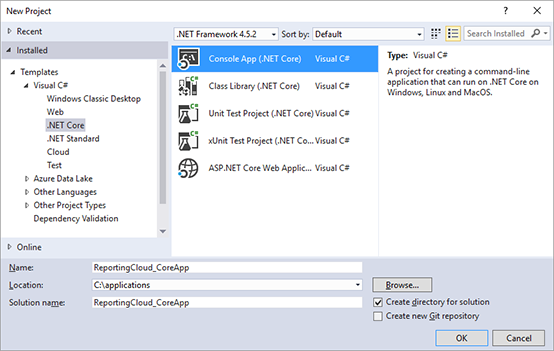
-
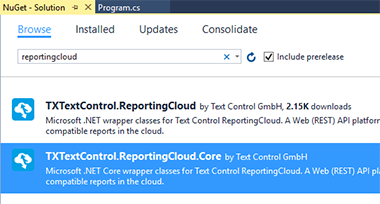
Click NuGet Package Manager -> Manage NuGet Packages for Solution... from the Tools main menu. Click on Browse and search for ReportingCloud. Select TXTextControl.ReportingCloud.Core:
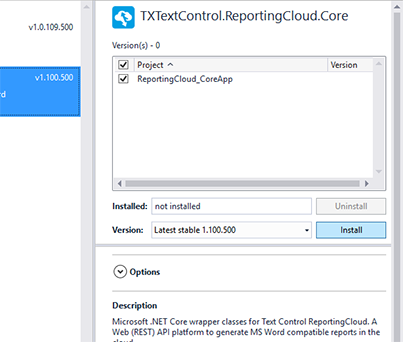
Select your project, choose the latest version and confirm with Install (confirm the opened license agreements of the included dependencies):
-
Open the Program.cs and paste the following code into it:
using System;
using System.Collections.Generic;
using TXTextControl.ReportingCloud;

namespace ReportingCloud_CoreApp
{
    class Program
    {
        static void Main(string[] args)
        {
            ReportingCloud rc = new ReportingCloud("username", "password");
            List<Template> lMyTemplates = rc.ListTemplates();

            foreach (Template template in lMyTemplates) {
                Console.WriteLine(template.TemplateName);
            }

            Console.ReadKey();
        }
    }
}
Replace username and password with your ReportingCloud credentials.
On executing, it returns the template names stored in your template storage.
Cloud
Are we moving to the cloud? This question is changing from "if" to "when" and "how". Text Control ReportingCloud brings complete reporting functionality to the cloud so all developers can use it, irrespective of the platform or language they're using. Its highly RESTful API can be used to merge Microsoft Word compatible templates with JSON data from all clients including .NET, Javascript, PHP, Node.JS, jQuery, Ruby, Python, Android, Java and iOS.
Related Posts
CloudMicroservicesReportingCloud
Sharing Documents with ReportingCloud
ReportingCloud introduces a DocumentViewer widget that embeds shared documents into any website. The new document/share endpoint returns an encrypted hash pointing to a template in cloud storage.…
CloudReportingCloudSample Templates
ReportingCloud: Sample Template Gallery Launched
The ReportingCloud portal now features a sample template gallery with tagged, filterable entries. Each template includes a description and animated merge preview. The Add to My Templates button…
CloudMicroservicesReportingCloud
The End of Monolithic Applications? Outsource Your Document Generation and…
Microservices decompose monolithic applications into independently deployable components that scale and update without affecting the full system. ReportingCloud operates as a document generation…
Proofing Tools Available As ReportingCloud Web API Endpoints
ReportingCloud introduces three proofing Web API endpoints for cloud-based spell checking. The proofing/check endpoint detects misspelled words and duplicates, proofing/suggestions returns ranked…
All Google Fonts Now Available in ReportingCloud
ReportingCloud now includes over 2000 Google Fonts on its servers, ensuring consistent rendering across merged documents. The fonts/list endpoint returns all available font names for programmatic…