









Extract Plain Text from Office Open XML DOCX and DOC Documents in ASP.NET Core C#

This article shows how to extract plain text from Office Open XML DOCX and DOC documents in ASP.NET Core C#. It shows how to convert the binary DOCX and DOC files to plain text using the ServerTextControl class and how to extract specific areas of the document.

Extracting plain text from Office Open XML DOCX and DOC files is required in many different applications. Whether you are indexing text for a search engine, an AI-powered text analytics tool, or a text-to-speech system, you need to extract text from DOCX and DOC files. In this article, we will show you how to extract plain text from DOCX and DOC files using C#.
TX Text Control provides a very powerful API to extract text from DOCX and DOC files. You can convert the entire document or just a specific range of pages or text between two specific text positions. The following code shows how to extract plain text from a DOCX file using TX Text Control:
Preparing the Application
A .NET 6 console application is created for the purposes of this demo.
Prerequisites
The following tutorial requires a trial version of TX Text Control .NET Server.
-
In Visual Studio, create a new Console App using .NET 8.
-
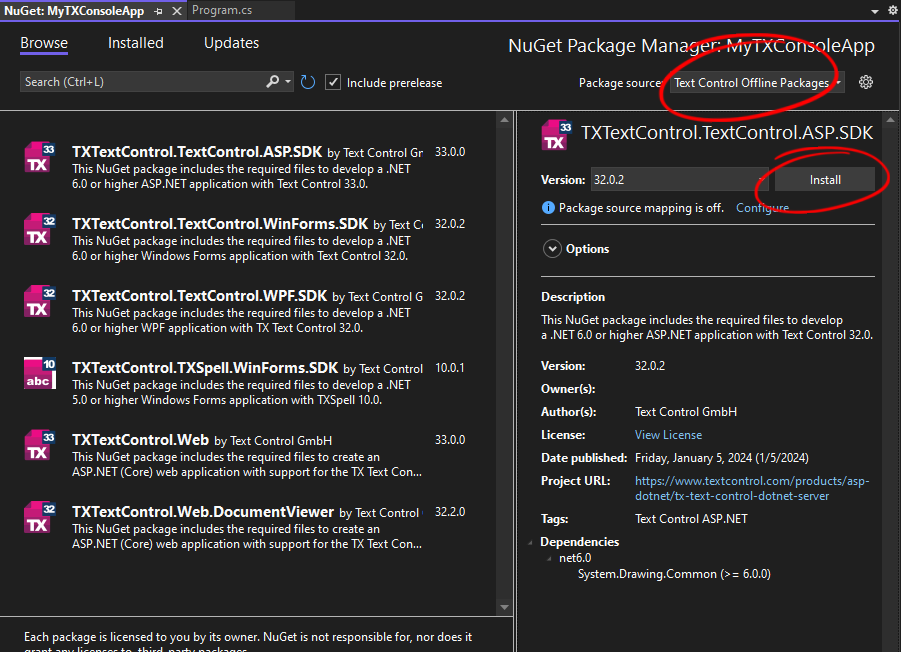
In the Solution Explorer, select your created project and choose Manage NuGet Packages... from the Project main menu.
Select Text Control Offline Packages from the Package source drop-down.
Install the latest versions of the following package:
- TXTextControl.TextControl.ASP.SDK
Extracting Text from DOCX Files
After installing the required NuGet package, you can use the following code to extract plain text from a DOCX file:
try
{
  using TXTextControl.ServerTextControl tx = new TXTextControl.ServerTextControl();

  tx.Create();

  tx.Load("document.docx", TXTextControl.StreamType.WordprocessingML);
  tx.Save(out string plainText, TXTextControl.StringStreamType.PlainText);

  Console.WriteLine(plainText);
}
catch (Exception ex)
{
  Console.WriteLine($"An error occurred: {ex.Message}");
}
The code snippet above loads a DOCX file and extracts the complete plain text from the document. The extracted text is then written to the console.
Extracting Text Between Headings
TX Text Control provides a powerful API to extract text between two specific text positions. Consider a scenario where you want to get all the text sections between chapter titles that are defined by stylesheets.
Consider the following document:
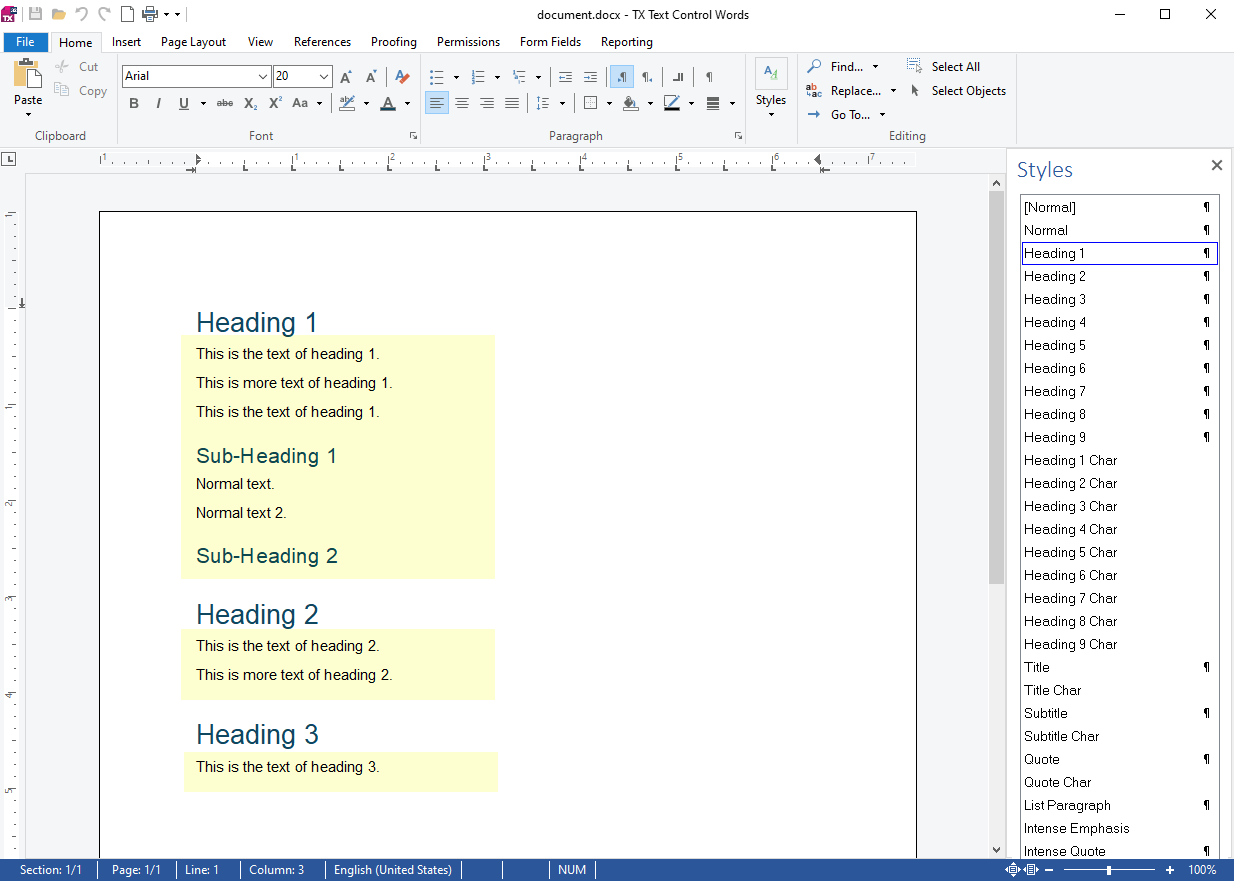
We want to extract the complete text between the headings with the stylesheet names Heading1. The following code shows how to extract the text between these two headings:
List<string> ExtractTextBlocks(string paragraphStyleName, ServerTextControl serverTextControl, bool includeRemainingText)
{
    List<string> textBlocks = new List<string>();
    bool capturing = false;
    StringBuilder currentBlock = new StringBuilder();

    for (int i = 1; i < serverTextControl.Paragraphs.Count - 1; i++)
    {
        Paragraph paragraph = serverTextControl.Paragraphs[i];

        if (paragraph.FormattingStyle == paragraphStyleName)
        {
            if (capturing)
            {
                textBlocks.Add(currentBlock.ToString().Trim());
                currentBlock.Clear();
            }
            else
            {
                capturing = true;
            }
        }
        else if (capturing)
        {
            currentBlock.AppendLine(paragraph.Text);
        }
    }

    // Add remaining text if still capturing at the end
    if (includeRemainingText && (capturing || currentBlock.Length > 0))
    {
        textBlocks.Add(currentBlock.ToString().Trim());
    }

    return textBlocks;
}
The code snippet below loads a DOCX file and extracts the text between two specified headings. It then prints the extracted text to the console.
using TXTextControl.ServerTextControl tx = new TXTextControl.ServerTextControl();
tx.Create();
tx.Load("document.docx", TXTextControl.StreamType.WordprocessingML);

var test = ExtractTextBlocks("Heading 1", tx, true);

foreach (var item in test)
{
        Console.WriteLine("New block: \r\n\r\n" + item + "\r\n");
}
The result is a list of three items containing the text between all headings named Heading 1.
New block:

This is the text of heading 1.

This is more text of heading 1.

This is the text of heading 1.

Sub-Heading 1

Normal text.

Normal text 2.

Sub-Heading 2

New block:

This is the text of heading 2.

This is more text of heading 2.

New block:

This is the text of heading 3.
If we now want to extract only the text between the Heading 2 styles, without adding the rest of the text that doesn't contain a closing style name, we can use the following code:
using TXTextControl.ServerTextControl tx = new TXTextControl.ServerTextControl();
tx.Create();
tx.Load("document.docx", TXTextControl.StreamType.WordprocessingML);

var test = ExtractTextBlocks("Heading 2", tx, false);

foreach (var item in test)
{
        Console.WriteLine("New block: \r\n\r\n" + item + "\r\n");
}
The following screenshot shows the extracted text between the Heading 2 styles:
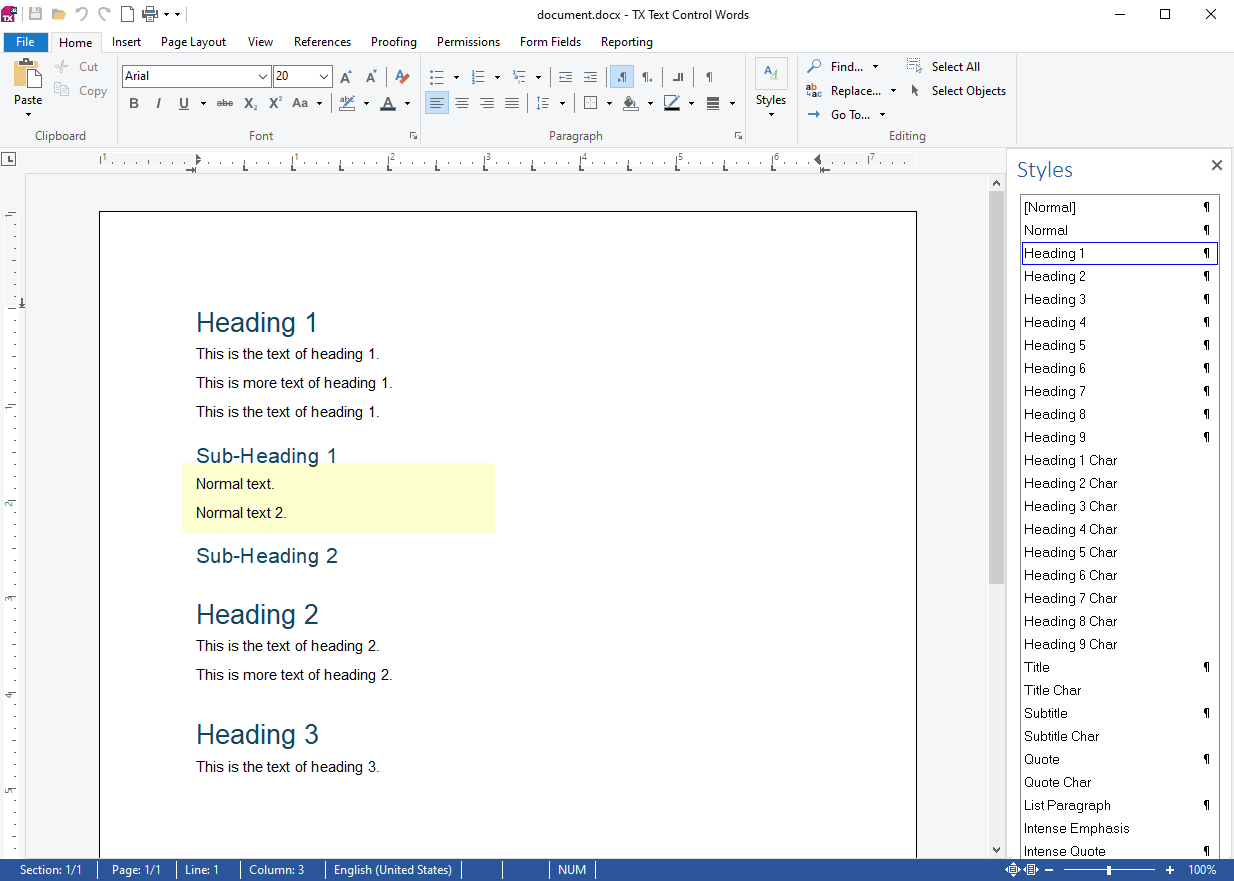
The result of the above code snippet is a block of text between the Heading 2 styles.
New block:

Normal text.

Normal text 2.
Conclusion
TX Text Control provides a powerful API to extract text from DOCX and DOC files. You can extract the complete text or just a specific range of text between two specific text positions. This article showed how to extract plain text from DOCX and DOC files using TX Text Control in C#.
ASP.NET
Integrate document processing into your applications to create documents such as PDFs and MS Word documents, including client-side document editing, viewing, and electronic signatures.





- Angular
- Blazor
- React
- JavaScript
- ASP.NET MVC, ASP.NET Core, and WebForms
Related Posts
Meet Text Control at code.talks 2026: Spreadsheets, Documents, and More
Text Control is heading to Hamburg for code.talks 2026 on November 4-5. Stop by our booth to meet the team, explore our latest developer technologies, and be among the first to experience TX Sheet…
Text Control Proudly Sponsors .NET Conf 2026
Text Control is proud to sponsor .NET Conf 2026, the annual virtual conference bringing together developers, Microsoft engineers, and industry experts from around the world. Taking place November…
Introducing TX Sheet Control: Excel Compatible Spreadsheets and Interactive…
We are pleased to introduce TX Sheet Control, the latest addition to the Text Control product family. TX Sheet Control brings together Excel-compatible spreadsheet editing, a powerful calculation…
ASP.NETASP.NET CoreDocument Conversion
Convert DOCX to PDF, PDF/A and PDF/UA in C# Using TX Text Control
Learn how to convert Word DOCX documents to PDF in C# using TX Text Control .NET Server. This tutorial covers file-based and in-memory conversion, PDF/A export, document metadata, font deployment,…
ASP.NETASP.NET CoreContent Controls
How to Extract Structured Data from Word Documents in C#
Learn how to extract tables, content controls, legacy form fields, and document metadata from Word documents with TX Text Control. This generic C# sample preserves the structure of documents and…