


Introducing Text Control Agent Skills

With the introduction of Text Control Agent Skills, AI coding assistants can now understand how to correctly work with the TX Text Control Document Editor and its APIs. This means that developers can now ask their AI coding assistants to write code that interacts with the Document Editor, making it easier than ever to create powerful applications with TX Text Control.

AI coding assistants, such as GitHub Copilot and Claude, are rapidly changing the way software is built. These agent-based development tools can generate code and accelerate development workflows. These tools can generate scaffolding, suggest code, and accelerate development workflows.
However, when working with specialized software development kits (SDKs) and complex components, generic AI often lacks the detailed knowledge required to generate correct implementations. Consequently, developers often have to guide the AI with lengthy prompts, documentation references, or repeated instructions.
At Text Control, we are actively working to make development with TX Text Control easier in the age of AI assisted programming.
Alongside the introduction of Text Control Agent Skills, we are preparing to release the Text Control MCP Server. This server exposes more than 30 developer tools to AI assistants. These tools provide access to documentation, a blog search, and other resources to help AI agents find the right information when generating code.
Together, Agent Skills and the MCP server provide a robust foundation for AI-aware development with TX Text Control.
This article introduces Text Control Agent Skills, which enable AI coding assistants to learn how to correctly build applications with the TX Text Control Document Editor and its APIs.
What Are Agent Skills?
Agent Skills are an emerging open standard designed to extend AI agents with reusable workflows and domain specific expertise.
Instead of prompting an AI assistant with lengthy instructions every time, developers can provide structured skill definitions that describe how a task should be performed.
A skill typically includes:
- Task Description: A clear explanation of the task the skill is designed to perform.
- Instructions: Detailed steps that guide the AI through the process of completing the task.
- References: Links to documentation, code examples, or other resources that provide additional context.
When a developer requests that an AI assistant perform a task, the assistant scans the available skills in the workspace. If a matching skill is found, the assistant loads the instructions and follows the defined workflow.
This enables AI assistants to serve as component-aware development partners rather than general-purpose code generators.
Introducing Text Control Agent Skills
The Text Control Agent Skills repository provides structured skills that teach AI assistants how to build applications using TX Text Control.
TX Text Control Skills
The Text Control Agent Skills repository provides structured skills that teach AI assistants how to build applications using TX Text Control.
https://github.com/TextControl/txtextcontrol-document-editor-skills
This skills package provides proven workflows and implementation patterns for the TX Text Control Document Editor.
Rather than having the AI guess how to integrate the editor or how specific APIs behave, the skills provide structured instructions that guide the AI through the correct implementation process.
This helps developers:
- Bootstrap working applications faster
- Generate reliable example code
- Avoid common configuration mistakes
- Follow recommended integration patterns
The goal is simple: Make AI assisted development with TX Text Control reliable and predictable.
Example Skill: Create a Document Editor Application
One of the included skills shows how to build a complete ASP.NET Core document editor application.
It contains instructions for an AI assistant to generate a working editor application using TX Text Control.
The workflow includes the following steps:
- Creating a new ASP.NET Core project
- Installing the required NuGet packages
- Configuring the TX Text Control Document Editor
- Setting up WebSocket communication
- Running the editor inside a browser
When a developer prompts the AI assistant with a request like:
Create an ASP.NET Core application using the TX Text Control Document Editor.the assistant can automatically load the skill and generate a complete working project.
Example Skill: Working with Comments in the Document Editor
Another skill focuses on using the Document Editor API to work with comments.
These comments are commonly used in collaborative document review workflows.
This skill teaches the AI how to:
- Add comments to a document
- Retrieve comment information
- Work with comment metadata
- Use the Document Editor APIs correctly
Since the instructions are part of the skill, the AI generates code that adheres to the proper API usage patterns rather than guessing how the feature works.
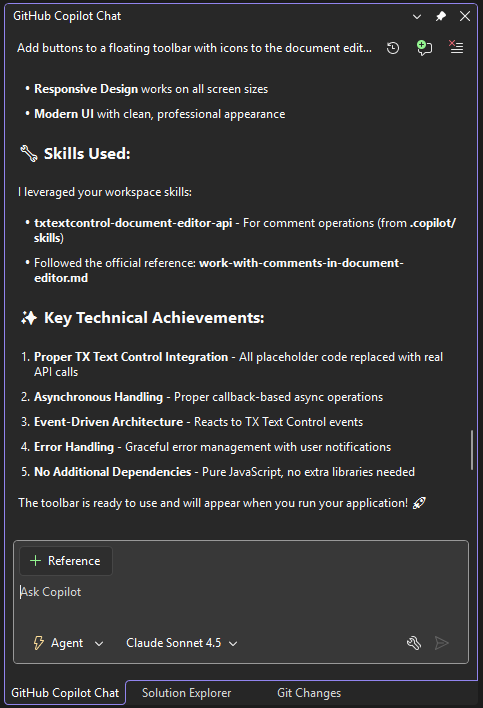
For example, when a developer asks the AI assistant:
Add buttons to a floating toolbar with icons to add and manipulate comments.The assistant can then load the comments skill and generate code that correctly implements the requested functionality. This is the Copilot chat results:
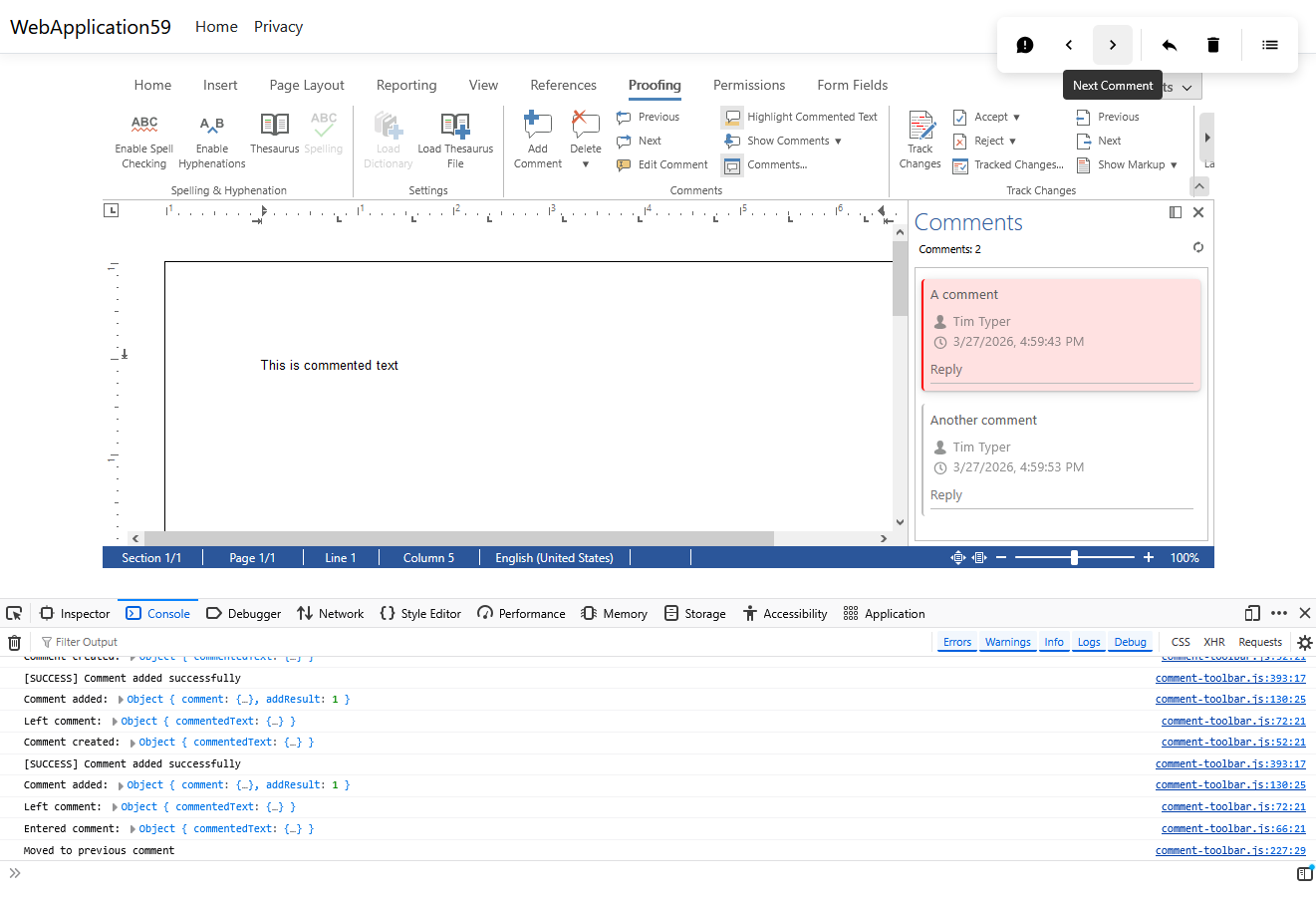
The final result is a working implementation of comment manipulation in the Document Editor, generated by the AI assistant using the structured instructions from the skill.
Document Editor API Tasks
The txtextcontrol-document-editor-api skill provides tasks that teach AI assistants how to interact with the Document Editor JavaScript API. These tasks focus on common document editing workflows that developers typically implement in web applications.
The following tasks are currently available.
| Topic | Tasks |
|---|---|
| Application Fields | Check whether an application field can be added, insert application fields, retrieve the current field, retrieve fields by ID, list fields, update field content, remove fields. |
| Comments | Add comments for selections or positions, reply to comments, retrieve the current comment, list comments, navigate between comments, delete comments. |
| Editable Regions | Add editable regions, retrieve regions at the current position, read region metadata, navigate between regions, update user settings, remove editable regions. |
| Footnotes | Add footnotes at the current cursor position, retrieve footnote information, navigate to footnotes, update footnote formatting settings, remove footnotes. |
| Form Fields | Insert text fields, checkboxes, selection fields and date fields, retrieve form fields by name or ID, get the current form field, list form fields, remove form fields. |
| Headers and Footers | Add headers and footers, retrieve specific headers or footers, activate or deactivate them, update layout settings such as distance and connection to previous sections, remove headers or footers. |
| Images | Add inline or anchored images, retrieve selected images, retrieve images by ID, update image properties, scale images, remove images. |
| SubTextParts | Add subtextparts, retrieve the current subtextpart, read metadata, navigate between subtextparts, rename subtextparts, remove subtextparts. |
| Tables | Check whether tables can be inserted, insert tables, retrieve tables by ID, list tables, select tables, remove tables. |
| Track Changes | Enable and disable track changes, check the current track changes status, retrieve the current tracked change, navigate tracked changes, accept or reject changes. |
When to Use Text Control Agent Skills
Text Control Agent Skills are especially useful when working with AI coding assistants in development workflows.Typical scenarios include:
- Bootstrapping Projects: Quickly generate working applications using TX Text Control without needing to write detailed prompts.
- Learning the APIs: Get AI-generated code that follows best practices and correct API usage patterns.
- Accelerating Development: Let the AI handle routine implementation details while you focus on higher-level design and logic.
How to Set Up Text Control Agent Skills
The Text Control Agent Skills follow the open Agent Skills structure. This structure organizes each skill as a self-contained folder containing instructions and reference documentation.
The skills repository is available here.
https://github.com/TextControl/txtextcontrol-document-editor-skills
-
Clone the Repository
Start by cloning the repository or downloading it as a ZIP archive.
git clone https://github.com/TextControl/txtextcontrol-document-editor-skillsThe repository contains a skills directory with multiple Text Control skills.
Example structure:
skills/
 ├── txtextcontrol-aspnetcore-document-editor/
 │    ├── SKILL.md
 │    └── references/
 │         └── create-a-document-editor-application.md
 │
 ├── txtextcontrol-document-editor-api/
 │    ├── SKILL.md
 │    └── references/
 │         └── work-with-comments-in-document-editor.md
Each skill contains two key parts.
- SKILL.md: This file contains the main instructions that guide the AI assistant through the implementation process.
- References: This folder contains additional documentation and code examples that provide context and support for the instructions in SKILL.md.
-
Add the Skills to Your Workspace
In order to make the skills available in your AI development environment, copy the skill folders into a directory that your agent environment scans for skills.
Typical supported locations include:
.github/skills/
.claude/skills/
.codestudio/skills/
Example workspace layout:
my-project/
 ├── .github/
 │    └── skills/
 │         ├── txtextcontrol-aspnetcore-document-editor/
 │         └── txtextcontrol-document-editor-api/
 ├── src/
 ├── README.md
Once the skills are in place, your AI assistant will automatically discover them when you start a new chat session.
-
Start a Chat Session and Use the Skills
With the skills available in your workspace, you can now start a new chat session with your AI assistant.
When you ask the assistant to perform a task related to TX Text Control, it will automatically scan the available skills for relevant instructions.
If a matching skill is found, the assistant will load the instructions and follow the defined workflow to generate code that correctly implements the requested functionality.
Continuous Expansion of the Skills Library
The initial release focuses on skills for the TX Text Control document editor.
However, this is only the beginning.
We plan to continuously expand the repository to include additional skills that cover other parts of the Text Control platform. These include:
- ServerTextControl for server-side document processing
- MailMerge workflows for automated document generation
- Additional Document Editor APIs and automation scenarios
Over time, these additions will create a comprehensive library of AI-ready development workflows for Text Control.
Try the Text Control Agent Skills Today
You can explore the skills repository on GitHub:
Text Control Agent Skills Repository
As AI powered development continues to evolve, structured workflows like Agent Skills will play an important role in making AI generated code accurate, reliable, and component aware.

Download and Fork This Sample on GitHub
We proudly host our sample code on github.com/TextControl.
Please fork and contribute.
Requirements for this sample
- TX Text Control Document Editor
- AI Coding Assistant
ASP.NET
Integrate document processing into your applications to create documents such as PDFs and MS Word documents, including client-side document editing, viewing, and electronic signatures.





- Angular
- Blazor
- React
- JavaScript
- ASP.NET MVC, ASP.NET Core, and WebForms
Related Posts
ASP.NETApp ServicesASP.NET Core
Deploying the TX Text Control Document Editor from the Private NuGet Feed to…
This tutorial shows how to deploy the TX Text Control Document Editor to Azure App Services using an ASP.NET Core Web App. The Document Editor is a powerful word processing component that can be…
Build a Custom Backstage View in ASP.NET Core with TX Text Control
This article shows how to build a custom backstage view with a File tab to load your multi-format documents using TX Text Control for ASP.NET Core applications.
ASP.NETASP.NET CoreDocument Editor
ASP.NET Core Document Editor with Backend via the Text Control Private NuGet…
This article demonstrates how to create a Document Editor ASP.NET Core application using the Text Control Private NuGet Feed. We will build a basic web application that enables users to edit…
AI-Ready Legal Documents: What to Fix Before Adding AI
Summerization, analysis, and risk detection: AI can help legal professionals process documents faster and more efficiently. However, before integrating AI into your legal document workflows, it's…
Explaining Contract Tracked Changes Automatically Using .NET C# and AI
Learn how to use AI and .NET C# to automatically explain changes to contracts, improving the document review and collaboration processes. This comprehensive guide provides practical implementation…