


AI Generated PDFs, PDF/UA, and Compliance Risk: Why Accessible Document Generation Must Be Built Into the Pipeline in C# .NET

Ensuring that PDFs are accessible and compliant with standards like PDF/UA is crucial. This article explores the risks of non-compliance and the importance of integrating accessible document generation into the C# .NET development pipeline.

At first glance, AI is accelerating document automation. Developers can use OCR to extract data, generate contracts and notices from templates, and export PDFs on a large scale with minimal human intervention. While this speed is valuable, it also creates a serious compliance issue. An automated pipeline can produce thousands of inaccessible PDFs just as easily as it can produce thousands of accessible ones. The risk of inaccessibility scales with automation.
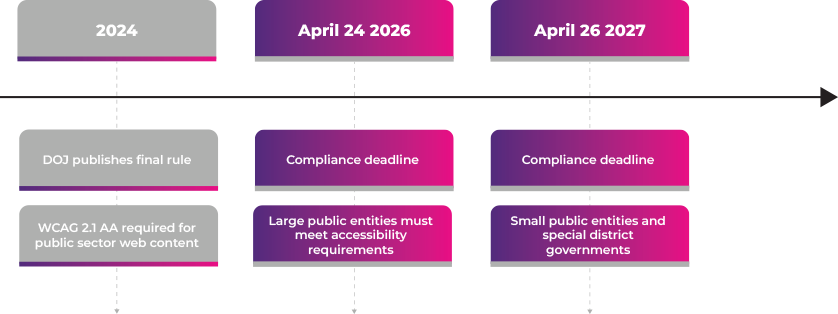
For public sector entities in the United States, the legal standard is becoming increasingly concrete. The Department of Justice's Americans with Disabilities Act (ADA) Title II rule requires state and local governments to make their web content and mobile apps accessible. The rule uses the Web Content Accessibility Guidelines (WCAG) 2.1 AA as the technical standard. Compliance dates begin on April 24, 2026, for larger public entities and on April 26, 2027, for smaller ones and special district governments.
U.S. ADA Title II Accessibility Rule
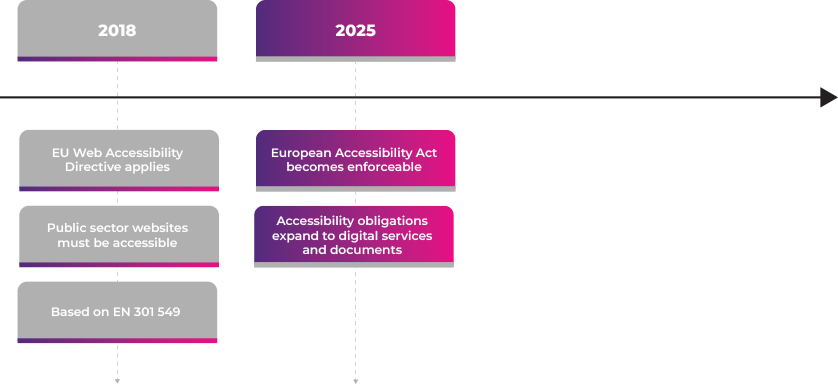
The European Accessibility Act is already in effect in the EU, and the broader EU digital accessibility framework is tied to harmonized standards such as EN 301 549. In practice, inaccessible PDFs are no longer just a usability problem. They can also become a legal liability.
PDF/UA and the European Accessibility Act Framework
The most important accessibility standard for PDFs is PDF/UA (ISO 14289). PDF/UA requires a properly tagged document structure, a logical reading order, alternative text for non-text content, meaningful labels, language metadata, and usable semantics for assistive technology. A PDF that only looks right visually is not enough. It must also be understandable to screen readers and other accessibility tools.
Learn more
In this blog post, we will explore the differences between PDF/UA and PDF/A-3a, helping you choose the right format for your business needs. We will discuss the key features, benefits, and use cases of each format to guide your decision-making process.
PDF/UA vs. PDF/A-3a: Which Format Should You Use for Your Business Application?
This is precisely where many AI-driven pipelines break down. OCR can recover text, but it loses the semantic structure. The HTML-to-PDF conversion process may reproduce the appearance, but not the correct tagging model. Ad hoc open-source assemblies can generate files quickly but often miss headings, reading order, alt text, table summaries, or form labels without explicit accessibility intent. Even if the output looks polished, it may still fail accessibility validation.
TX Text Control is a leading document processing library for .NET. Beginning with version 34.0, it supports the generation of built-in PDF/UA and PDF/A-3a. The important point is not just that it exports PDFs. It automatically includes the necessary tagging and metadata for PDF/UA when the document itself contains the required accessibility information. In other words, the engine generates the PDF structure, while your application supplies semantic content, such as descriptive text and labels, where needed.
This division of responsibilities makes TX Text Control especially useful in AI-based workflows. Your pipeline can leverage AI for its strengths, such as generating descriptive text for images, links, and tables. Meanwhile, TX Text Control handles the deterministic tasks, such as building the tagged PDF structure, preserving reading order, embedding metadata, and producing a standards-compliant output file. This design is much safer than relying on a loosely connected chain of OCR, HTML rendering, and PDF post-processing.
Why PDF/UA Is a Better Architectural Choice for AI Pipelines
A tagged PDF is better for more than just accessibility. It is also more machine-readable. Tagged PDFs make tables, lists, and alternative texts machine-readable. This allows AI systems to correctly interpret hierarchy and meaning instead of guessing from the order of plain text. In legal and regulated workflows, this is important because structure often carries meaning. If AI reads a contract or notice without reliable structure, the result may be inaccurate. However, if the same document is generated as a tagged PDF/UA, both humans and machines will get more reliable results.
This is the real compliance story. Accessibility and AI reliability are not separate concerns. They reinforce each other. A pipeline that preserves structure is more accessible, testable, and dependable. A pipeline that disregards structure creates usability and legal risks.
How Easy It Is to Generate PDF/UA with TX Text Control
The strongest practical argument for TX Text Control is that generating accessible output is simple. Version 34.0 can generate both PDF/UA and PDF/A-3a, and exported documents automatically include the necessary tagging and metadata for PDF/UA. For many business scenarios, this means you can maintain your current template-based generation process while transitioning to accessible output without redesigning the entire pipeline.
A minimal example is as simple as creating a document and saving it as a PDF/A file. TX Text Control 34.0 also supports the accessible tagged output required for PDF/UA-capable workflows.
using TXTextControl;

using var tx = new ServerTextControl();
tx.Create();

tx.Text = "This PDF was generated with TX Text Control.";

// Export as PDF/A-3a with tagged structure for accessibility workflows
tx.Save("result.pdf", StreamType.AdobePDFA);
Even if you need archival compliance and a digital signature, the code remains very small. The following code demonstrates that the same save call can combine digital signing with PDF/A-3a generation. The resulting file is compliant with both PDF/A-3a and PDF/UA.
using System.Security.Cryptography.X509Certificates;
using TXTextControl;

const string password = "123";
const string certificatePath = "certificate.pfx";

var cert = new X509Certificate2(
    certificatePath,
    password,
    X509KeyStorageFlags.Exportable);

using var tx = new ServerTextControl();
tx.Create();
tx.Text = "This document is digitally signed.";

var saveSettings = new SaveSettings
{
    DigitalSignature = new DigitalSignature(cert, null)
};

tx.Save("result.pdf", StreamType.AdobePDFA, saveSettings);
The key point is what TX Text Control does for you behind the scenes. The engine automatically generates the necessary tagging and metadata for PDF/UA. Developers do not have to manually build the structure tree in raw PDF syntax or stitch together a post-processing chain. The application focuses on document content and semantics while TX Text Control handles standards-aware PDF generation.
What You Still Need to Provide for PDF/UA Compliance
Although generating accessible PDFs is easy with TX Text Control, it's not magic. Full compliance depends on the completeness of the content you provide. For example, if some images lack alt text or links lack descriptions, the PDF may be technically structured, yet not fully compliant with PDF/UA. The same applies to missing table summaries, link descriptions, and required metadata.
This issue can be resolved by using the TX Text Control API and AI to generate the missing content. For example, you can use AI to create descriptions of images, links, and tables. Then, this content can be added to the document using the API before exporting to PDF/UA. This allows you to leverage the strengths of AI while relying on TX Text Control for deterministic PDF generation.
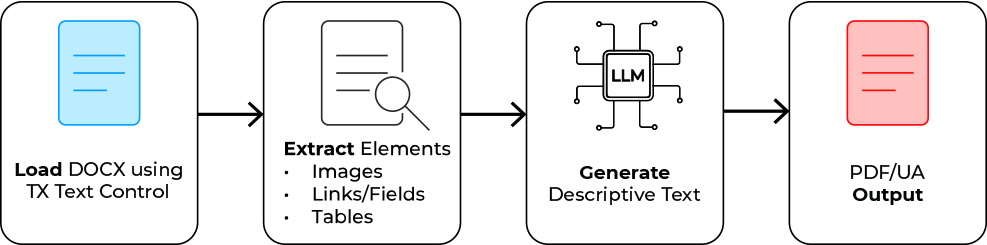
The diagram above illustrates the workflow: First, TX Text Control loads the document. Then, the elements are iterated and extracted and sent to the LLM. Next, the returned text is added as descriptive text to the extracted elements. Finally, TX Text Control exports the document to PDF/UA.
Learn more
This article shows how to use TX Text Control together with the OpenAI API to automatically add descriptive texts (alt text and labels) to images, links, and tables in a DOCX. The resulting document is then exported as a PDF/UA compliant PDF document.
Automating PDF/UA Accessibility with AI: Describing DOCX Documents Using TX Text Control and LLMs
Validation Should Be Part of the Pipeline
For compliance-sensitive workflows, generation should not be the final step. Validation should also be automated. TX Text Control provides a PDF validation package that inspects generated PDFs for issues such as missing alternative text, incorrect structural elements, and missing metadata. This is important because accessibility is not just about intent. It's about verifiable output. If your pipeline produces inaccessible PDFs, you need to know about it before they go out the door. Automated validation allows you to catch issues early and maintain a high standard of accessibility.
Learn more
The new TXTextControl.PDF.Validation NuGet package enables you to validate PDF/UA documents and verify digital signatures directly in your code without relying on third-party tools or external services.
Validate PDF/UA Documents and Verify Electronic Signatures in C# .NET
TX Text Control's published validation checks include a PDF/UA conformance declaration, tagging status, a presence of a structure tree, language metadata, a document title, alt text for figures, link descriptions, form tooltips, and table-related requirements. This makes it possible to transform accessibility into a measurable continuous integration (CI) or quality assurance (QA) gate rather than a manual afterthought.
The Legal Implication for AI Driven Document Workflows
The legal implication is straightforward. If your organization distributes inaccessible PDFs via the web or mobile channels, the fact that they were generated by AI does not reduce your responsibility. The law evaluates the accessibility of the final product, not the efficiency or technology used in the production process. According to the DOJ's Title II rule, state and local governments must ensure that their web content and mobile applications are accessible. In Europe, accessibility obligations are already in effect under the EAA framework and related standards. An automated document system that produces inaccessible PDFs on a large scale increases exposure, not protection.
This is why PDF/UA should be treated as a system requirement rather than a desirable export option. TX Text Control is a strong fit for serious document automation for this reason. TX Text Control gives developers a deterministic document engine with built-in PDF/UA and PDF/A-3a generation and validation tooling that can be integrated directly into application code.
Conclusion
The legal implication is straightforward. If your organization distributes inaccessible PDFs via the web or mobile channels, the fact that they were generated by AI does not reduce your responsibility. The law evaluates the accessibility of the final product, not the efficiency or technology used in the production process. According to the DOJ's Title II rule, state and local governments must ensure that their web content and mobile applications are accessible. In Europe, accessibility obligations are already in effect under the EAA framework and related standards. An automated document system that produces inaccessible PDFs on a large scale increases exposure, not protection.
This is why PDF/UA should be treated as a system requirement rather than a desirable export option. TX Text Control is a strong fit for serious document automation for this reason. TX Text Control gives developers a deterministic document engine with built-in PDF/UA and PDF/A-3a generation and validation tooling that can be integrated directly into application code.
Frequently Asked Questions
AI-powered document pipelines often combine OCR, template generation, and PDF export. While these systems can produce documents quickly, they frequently lose semantic structure during processing. OCR may recover text but remove headings, lists, and table structure. HTML-to-PDF conversion may preserve visual layout but not accessibility tagging. As a result, automated systems can produce large numbers of PDFs that appear correct visually but fail accessibility standards such as PDF/UA.
In the United States, the Department of Justice ADA Title II rule requires state and local governments to ensure that web content and mobile applications are accessible according to WCAG 2.1 AA. Compliance deadlines begin April 24, 2026 for larger public entities and April 26, 2027 for smaller entities and special district governments. In the European Union, accessibility requirements are already active under the European Accessibility Act and related standards such as EN 301 549.
PDF/UA (ISO 14289) is the international standard for accessible PDF documents. It defines how PDFs must include semantic structure such as headings, lists, tables, alternative text, language metadata, and logical reading order. This structure allows assistive technologies such as screen readers to correctly interpret the document. A visually correct PDF without proper tagging is not considered accessible.
TX Text Control is a document processing library for .NET that supports generating PDF/UA and PDF/A-3a documents. The engine automatically creates the required tagged PDF structure and metadata during export. Developers only need to provide the semantic content, such as headings, descriptive text, and labels. TX Text Control then produces standards-compliant PDF output without requiring developers to manually build PDF tagging structures.
Yes. AI can be used to generate missing accessibility information such as alternative text for images, link descriptions, or table summaries. Using the TX Text Control API, this information can be added to the document before exporting it to PDF/UA. This approach combines the strengths of AI for content generation with the deterministic document generation capabilities of TX Text Control.
Accessible PDFs must contain a logical document structure with semantic tags for headings, paragraphs, lists, and tables. Images must include alternative text, links must have descriptive labels, and the document must specify language metadata and reading order. Interactive elements such as form fields must also include accessible labels and tooltips.
Accessibility compliance requires verifiable output. Automated pipelines can produce thousands of documents quickly, which makes manual verification impractical. Automated validation tools can inspect PDFs for missing alt text, incorrect tagging structures, missing metadata, or other accessibility issues. Integrating validation into CI or QA workflows ensures that inaccessible documents are detected before they are distributed.
The TXTextControl.PDF.Validation package allows developers to validate PDF/UA documents and verify digital signatures directly in their applications. The validator checks elements such as tagging status, structure tree presence, language metadata, document titles, alternative text for images, link descriptions, form tooltips, and table-related accessibility requirements.
Tagged PDFs are not only useful for accessibility but also improve machine readability. Structured documents allow AI systems to understand hierarchy, tables, and semantic meaning instead of relying on plain text order. This improves accuracy when AI systems analyze contracts, notices, or reports generated from document automation pipelines.
ASP.NET
Integrate document processing into your applications to create documents such as PDFs and MS Word documents, including client-side document editing, viewing, and electronic signatures.





- Angular
- Blazor
- React
- JavaScript
- ASP.NET MVC, ASP.NET Core, and WebForms
Related Posts
ASP.NETAccessibilityASP.NET Core
Upcoming Support for PDF/UA Compliance and Tagged PDF Generation in Version 34.0
We are happy to announce that version 34.0 will support PDF/UA compliance and the creation of tagged PDF documents. This significant update demonstrates our ongoing commitment to accessibility by…
Validate Digital Signatures and the Integrity of PDF Documents in C# .NET
Learn how to validate digital signatures and the integrity of PDF documents using the PDF Validation component from TX Text Control in C# .NET. Ensure the authenticity and compliance of your…
Validate PDF/UA Documents and Verify Electronic Signatures in C# .NET
The new TXTextControl.PDF.Validation NuGet package enables you to validate PDF/UA documents and verify digital signatures directly in your code without relying on third-party tools or external…
Introducing TX Text Control 34.0: Your Next Leap in Document Processing
We are happy to announce the release of TX Text Control 34.0. This version is packed with new features and enhancements that will elevate your document processing experience. This version…
PDF/UA vs. PDF/A-3a: Which Format Should You Use for Your Business Application?
In this blog post, we will explore the differences between PDF/UA and PDF/A-3a, helping you choose the right format for your business needs. We will discuss the key features, benefits, and use…