


A Complete Guide to Converting Markdown to PDF in .NET C#

Learn how to convert Markdown to PDF in .NET C# using Text Control's ServerTextControl component. This guide covers setup, conversion process, and customization options for generating high-quality PDF documents from Markdown content.
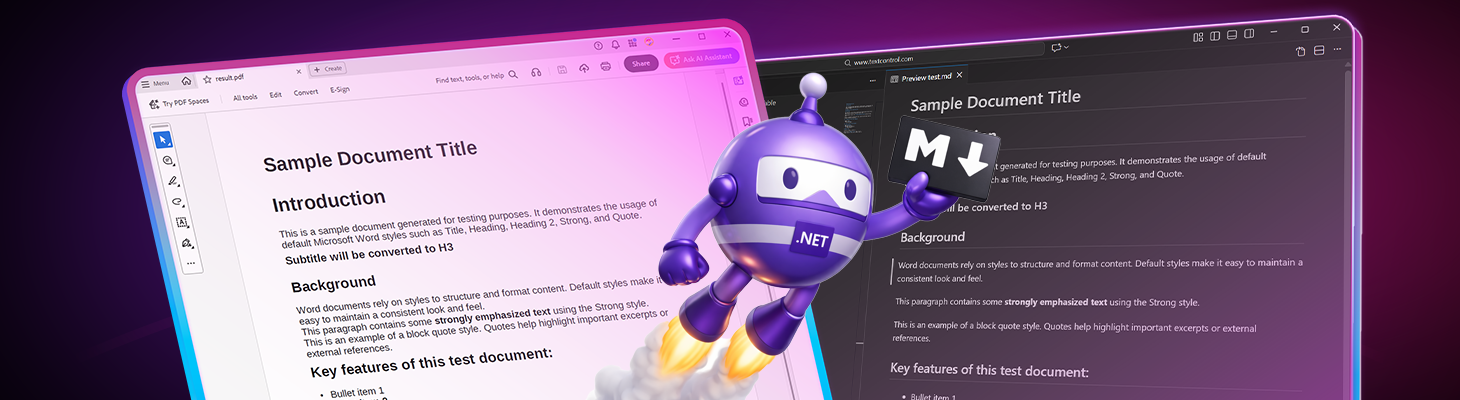
Markdown is one of the most popular markup languages used by developers and technical writers. Its clean, plain-text syntax makes it ideal for documentation, README files, and dynamic content generation. But what if you need to convert Markdown to a polished PDF from your .NET C# application?
This guide will teach you how to efficiently convert Markdown to PDF using modern .NET tools, including the recently introduced TXTextControl.Markdown.Core package.
Why convert Markdown to PDF?
Markdown's simplicity makes writing and maintaining content easy. However, when it comes to sharing, printing, compliance, or archiving, PDF remains the gold standard for document delivery. PDFs preserve formatting, are widely supported across platforms, and provide a professional appearance.
Converting Markdown to PDF in .NET C# is a powerful capability, whether you're building APIs that deliver PDF documents, generating reports from Markdown templates, or automating document pipelines.
Tools you can use in .NET C#
The tools you choose for converting Markdown to PDF in .NET C# directly affect performance, document fidelity, deployment complexity, and long-term maintainability. While there are many ways to approach this task, not all of them are suitable for production-grade document workflows.
One of the most straightforward options is TXTextControl.Markdown.Core, which natively integrates Markdown support into the TX Text Control document engine. With this approach, your Markdown content is parsed directly into a structured document object model that you can process, validate, and export without relying on intermediate representations. The document behaves like any other editable document in the TX Text Control ecosystem and can be handled using the same APIs you use for Word, RTF, or DOCX documents.
Since the Markdown content is loaded directly into the document model, you have complete control over the layout, pagination, headers and footers, fonts, and PDF export settings. This is especially valuable when precise formatting, branding, accessibility, or compliance requirements must be met before finalizing a document as a PDF.
Quick start: Markdown to PDF in .NET C#
Prerequisites
In order to follow this guide, you need to have:
- .NET 10.0 SDK or later installed on your development machine.
- A TX Text Control .NET Server license. You can download a free trial from here
To get started with converting Markdown to PDF in .NET C#, follow these steps:
-
Install TXTextControl.Markdown.Core: Add the TXTextControl.Markdown.Core NuGet package to your .NET project. You can do this via the NuGet Package Manager or by running the following command in the Package Manager Console:
Install-Package TXTextControl.Markdown.Core -Version 33.0.0-beta.4
Install-Package TXTextControl.TextControl.Core.SDK
These packages provide the core document engine and Markdown support.
-
Load and convert Markdown to PDF: Use the following sample code to load a Markdown string, convert it to a document, and export it as a PDF file:
using TXTextControl;
using TXTextControl.Markdown;

public class MarkdownPdfConverter
{
    public void ConvertMarkdownToPdf(string markdown, string outputPdfPath)
    {
        using var tx = new ServerTextControl();
        tx.Create();

        // Load Markdown text
        tx.LoadMarkdown(markdown);

        // Save as PDF
        tx.Save(outputPdfPath, StreamType.AdobePDF);
    }
}
This method will take a Markdown string and produce a PDF file at outputPdfPath.
var markdown = "# Hello World\nThis is a sample markdown text.";
var outputPdfPath = "output.pdf";
var converter = new MarkdownPdfConverter();
converter.ConvertMarkdownToPdf(markdown, outputPdfPath);
Console.WriteLine($"PDF generated at: {outputPdfPath}");
From Markdown file to PDF
If you have a Markdown file rather than a string, you can read its contents and pass them to the conversion method.
using TXTextControl;
using TXTextControl.Markdown;

var mdFilePath = "test.md";
var pdfOutputPath = "result.pdf";

string markdownContent = File.ReadAllText(mdFilePath);

using var tx = new ServerTextControl();
tx.Create();

// Load the Markdown from file
tx.LoadMarkdown(markdownContent);

// Save to PDF
tx.Save(pdfOutputPath, StreamType.AdobePDF);

Console.WriteLine($"PDF saved to {pdfOutputPath}");
Changing the page layout
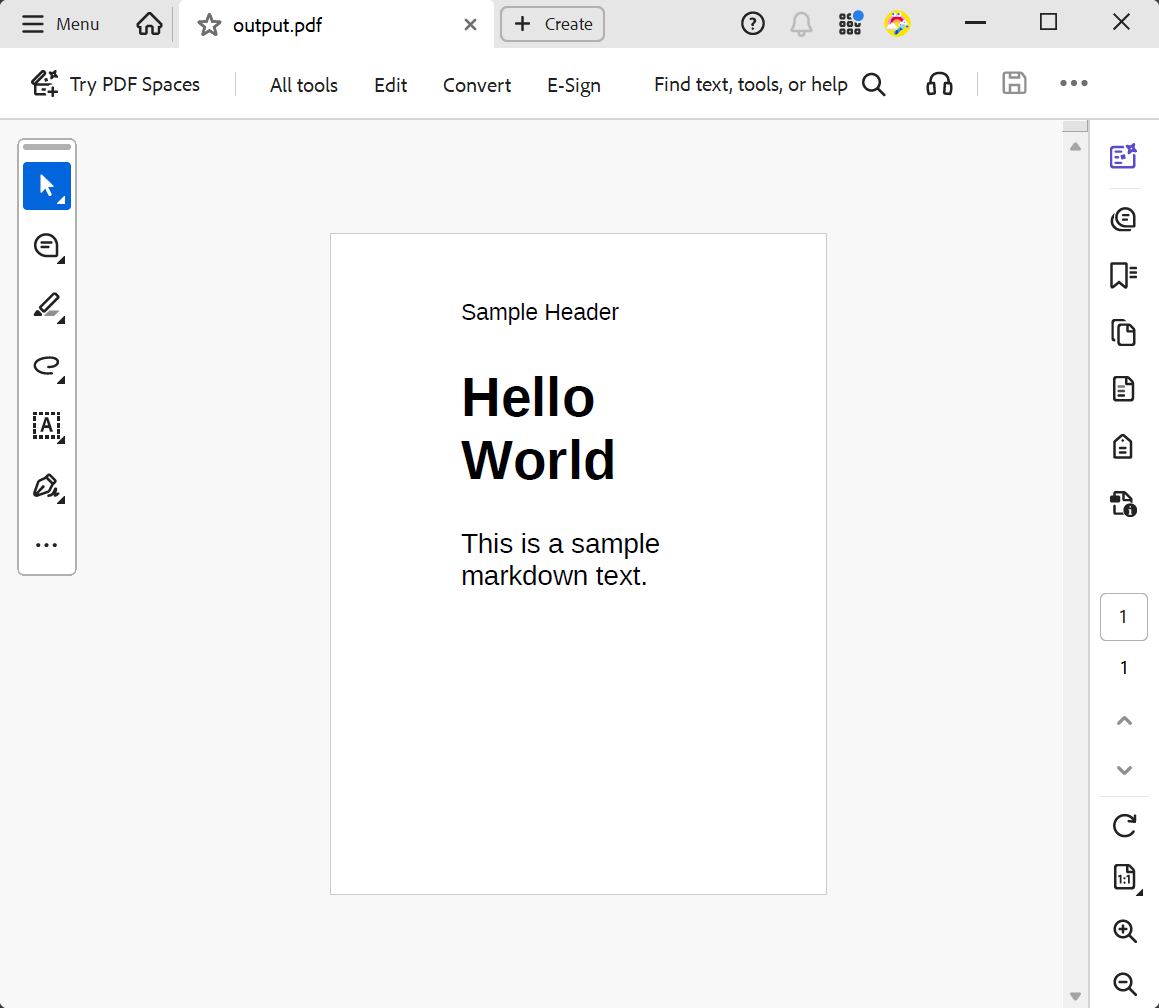
You can customize the page layout, margins, headers, and footers before exporting to PDF. Here's an example of setting up a custom page layout and headers and footers:
public void ConvertMarkdownToPdf(string markdown, string outputPdfPath)
 {
     using var tx = new ServerTextControl();
     tx.Create();

     // Load Markdown text
     tx.LoadMarkdown(markdown);

     tx.Sections[1].Format.PageSize = new TXTextControl.PageSize(300, 400); // Set custom page size if needed
     tx.Sections[1].HeadersAndFooters.Add(HeaderFooterType.Header);
     tx.Sections[1].HeadersAndFooters.GetItem(HeaderFooterType.Header).Selection.Text = "Sample Header";

     // Save as PDF
     tx.Save(outputPdfPath, StreamType.AdobePDF);
 }
These settings will result in an exported PDF with a small page size and custom headers and footers.
Changing the paragraph styles
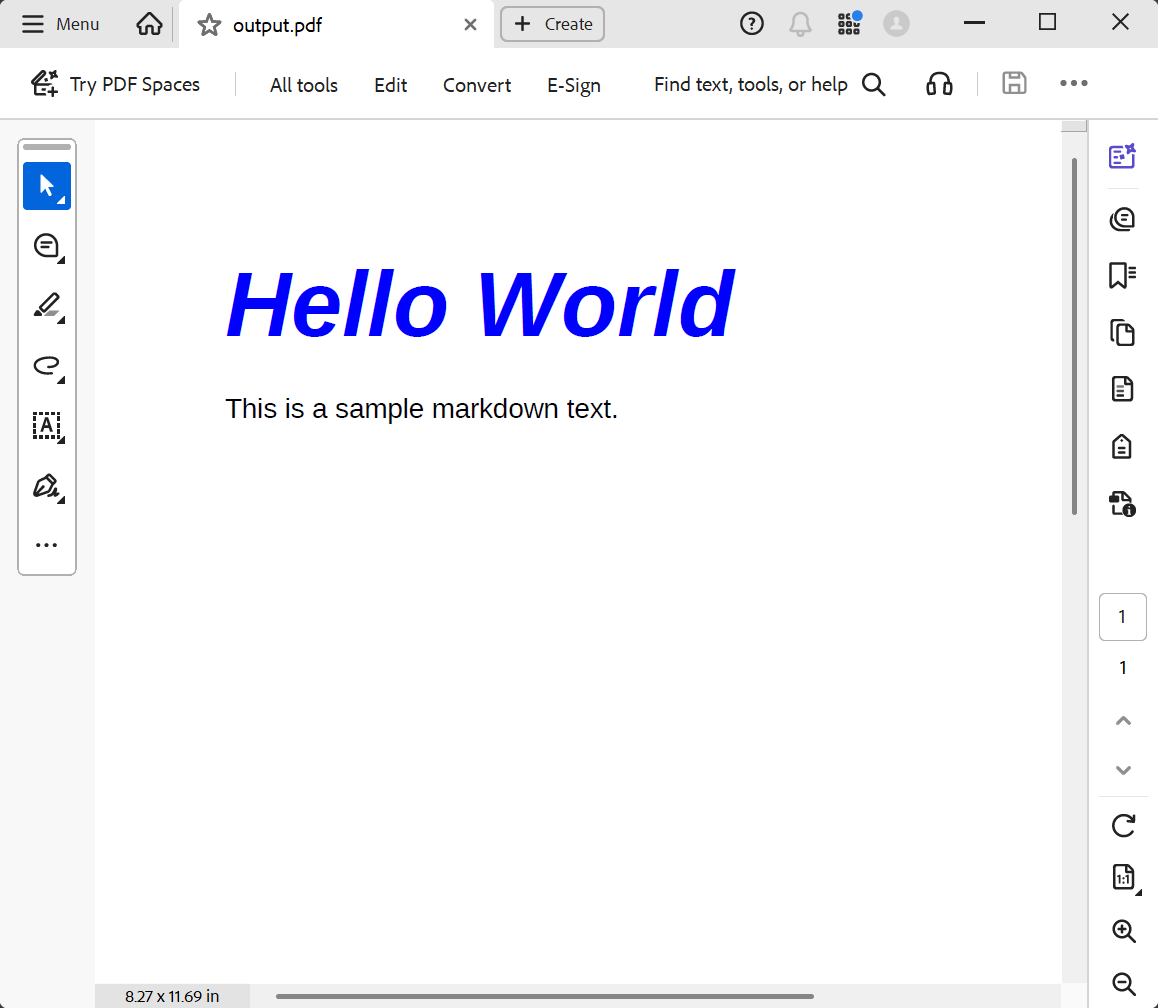
After loading the Markdown content, you can also modify the styles of paragraphs, headings, lists, and other elements. Here's an example of changing the font and color of all paragraphs:
public void ConvertMarkdownToPdf(string markdown, string outputPdfPath)
{
    using var tx = new ServerTextControl();
    tx.Create();

    // Load Markdown text
    tx.LoadMarkdown(markdown);

    var h1Style = tx.ParagraphStyles.GetItem("H1");

    h1Style.Italic = true;
    h1Style.FontSize = 800;
    h1Style.ForeColor = System.Drawing.Color.Blue;
    h1Style.Apply();

    // console out all style names
    foreach (ParagraphStyle style in tx.ParagraphStyles)
    {
        Console.WriteLine(style.Name);
    }

    // Save as PDF
    tx.Save(outputPdfPath, StreamType.AdobePDF);
}
The Markdown import feature automatically creates and imports formatting styles that can be modified programmatically. The above code outputs all imported styles to the console for inspection.
[Normal]
BODY
H1
H2
H3
H4
H5
H6
BLOCKQUOTE
PRE
CAPTION
TH
PDF generated at: output.pdf
The resulting PDF will have all H1 headings in size 800 and in blue.
Conclusion
Converting Markdown to PDF in .NET C# is easy with the right tools. Leveraging TXTextControl.Markdown.Core allows you to seamlessly integrate Markdown support into your document workflows, ensuring high-quality PDF output that meets your formatting and branding requirements.
Whether you're generating reports, documentation, or dynamic content, this approach provides a robust solution for handling Markdown in your .NET applications.
ASP.NET
Integrate document processing into your applications to create documents such as PDFs and MS Word documents, including client-side document editing, viewing, and electronic signatures.





- Angular
- Blazor
- React
- JavaScript
- ASP.NET MVC, ASP.NET Core, and WebForms
Related Posts
Convert Markdown to PDF in a Console Application on Linux and Windows
Learn how to convert Markdown files to PDF in a console application on Linux and Windows using TX Text Control .NET Server for ASP.NET. This tutorial provides step-by-step instructions and code…
ASP.NETASP.NET CoreE-Invoicing
Why Structured E-Invoices Still Need Tamper Protection using C# and .NET
ZUGFeRD, Factur-X, German e-invoicing rules, and how to seal PDF invoices with TX Text Control to prevent tampering. Learn how to create compliant e-invoices with C# and .NET.
Create Fillable PDFs from HTML Forms in C# ASP.NET Core Using a WYSIWYG Template
Learn how to generate PDFs from HTML forms in ASP.NET Core using a pixel-perfect WYSIWYG template. Extract form fields from a document, render a dynamic HTML form, and merge the data server-side…
Why HTML to PDF Conversion is Often the Wrong Choice for Business Documents…
In this article, we explore the challenges of HTML to PDF conversion for business documents in C# .NET and present alternative solutions that offer better performance and reliability. Discover why…
ASP.NETASP.NET CoreDocument Creation
Why PDF Creation Belongs at the End of the Business Process
This article discusses why placing PDF creation at the end of the business process is important for ensuring accuracy and efficiency. The most scalable systems delay PDF generation until the…